









Less Tense Herbal Tincture
for the woman who carries the day in her neck and shoulders
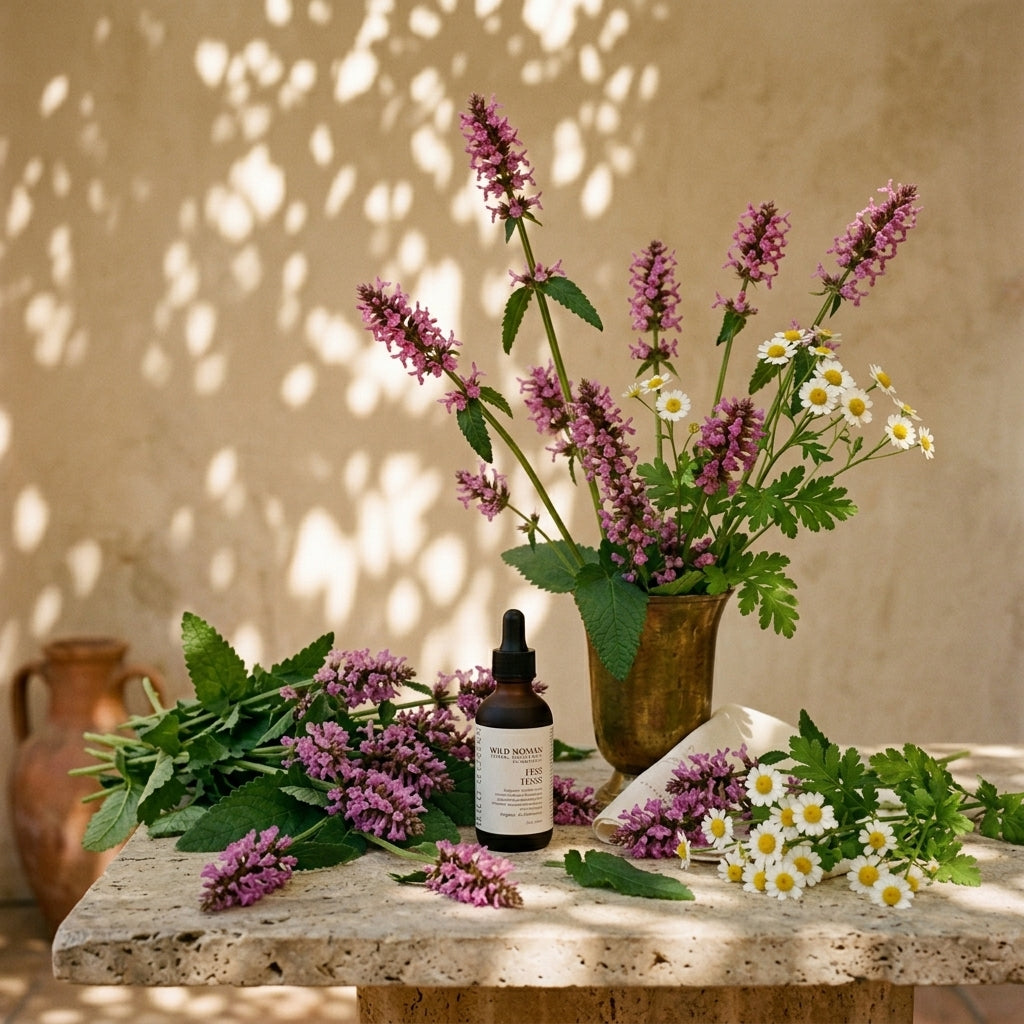
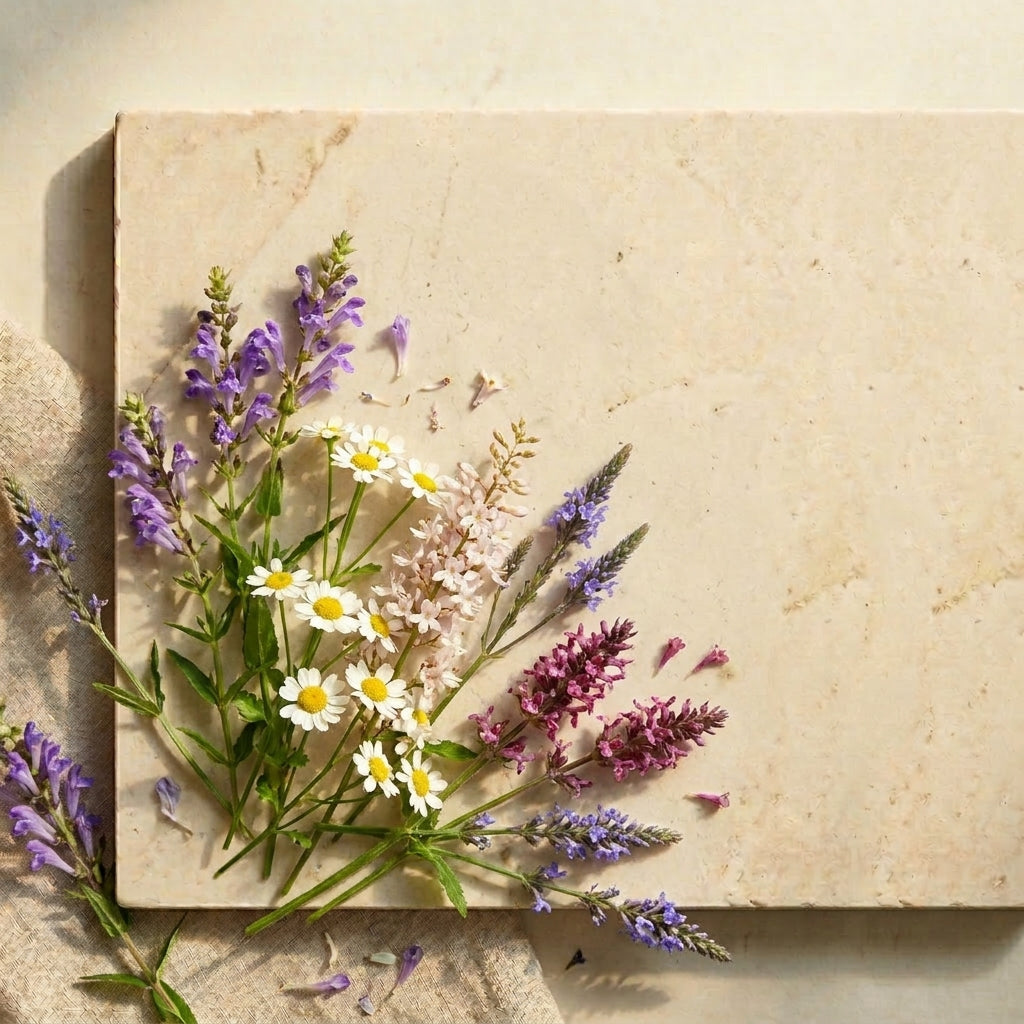
There is a particular kind of tension that builds slowly, behind the eyes, across the shoulders, in the hinge of the jaw, until it becomes the loudest thing in the room. Wood Betony (Betonica officinalis), Blue Vervain (Verbena hastata), Skullcap (Scutellaria lateriflora), and Feverfew (Tanacetum parthenium) have been traditionally used across centuries of European herbalism to support the body's release of head-centered tension rooted in stress and overstimulation. This is for the moment when you need to soften enough to return.
bitter and green · faintly floral · grounding · the taste of something working
Choose options
Less Tense
PRODUCT DETAILS
Wood Betony (Betonica officinalis) has been known in European herbal medicine for its particular affinity for the head: not just as a nervine, but as a plant that draws scattered energy downward, quieting the kind of mental heat that turns into pressure behind the eyes. It is where this formula begins, and everything that follows is built around its grounding intelligence.
Blue Vervain (Verbena hastata) works where tension is held above the shoulders, in the jaw, the upper trapezius, the back of the neck where stress gathers and stays. Skullcap (Scutellaria lateriflora) brings a deeper quieting, supporting the nervous system's capacity to loosen its grip on muscles that have been braced against a long and demanding day. Jamaican Dogwood (Piscidia piscipula) moves into the body's deeper holding, traditionally used in small amounts to support muscular ease in the head and neck when tension has rooted itself more persistently.
Feverfew (Tanacetum parthenium) carries centuries of use in Western herbal tradition to support the body during periods of head tension and migraine. Lavender (Lavandula angustifolia) finishes the formula as it does the day: aromatic, grounding, and steady, supporting nervous system ease in the body that has been carrying too much for too long.
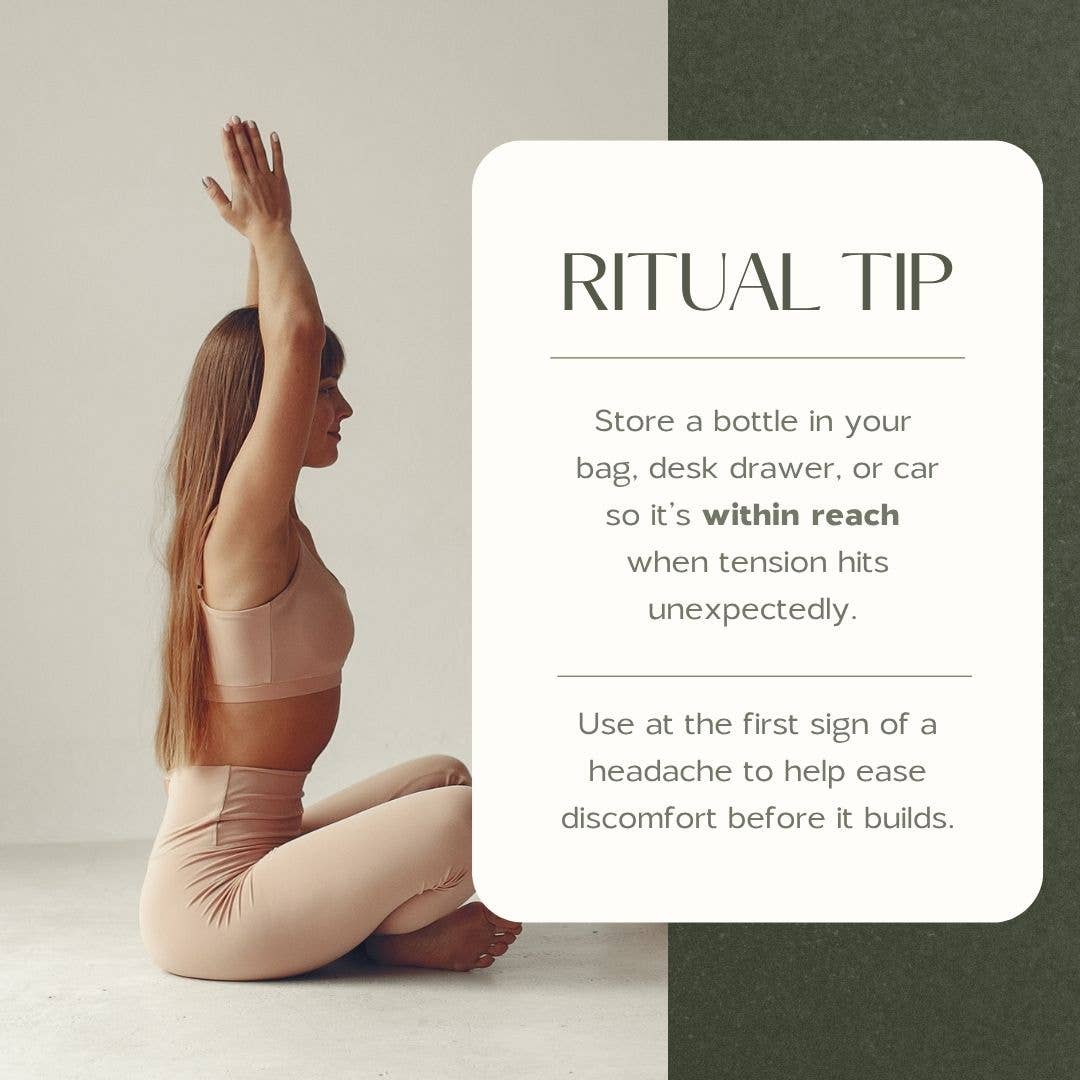
This is a formula for the overstretched day. For screen fatigue and mental strain. For the tension that builds before you notice it and announces itself somewhere behind your eyes. Reach for it at the first sign of gathering pressure: under the tongue, a small glass of water, a moment to breathe.
Every plant in this formula was chosen from knowledge: not from a catalog, but from years of working with these specific botanicals and understanding what they ask of the body and what they offer it in return. The herbs are USDA Certified Organic or responsibly wildcrafted, extracted in small batches using organic sugarcane extract and organic vegetable glycerin at a 1:5 ratio. Nothing about this formula was rushed. The plants were not.
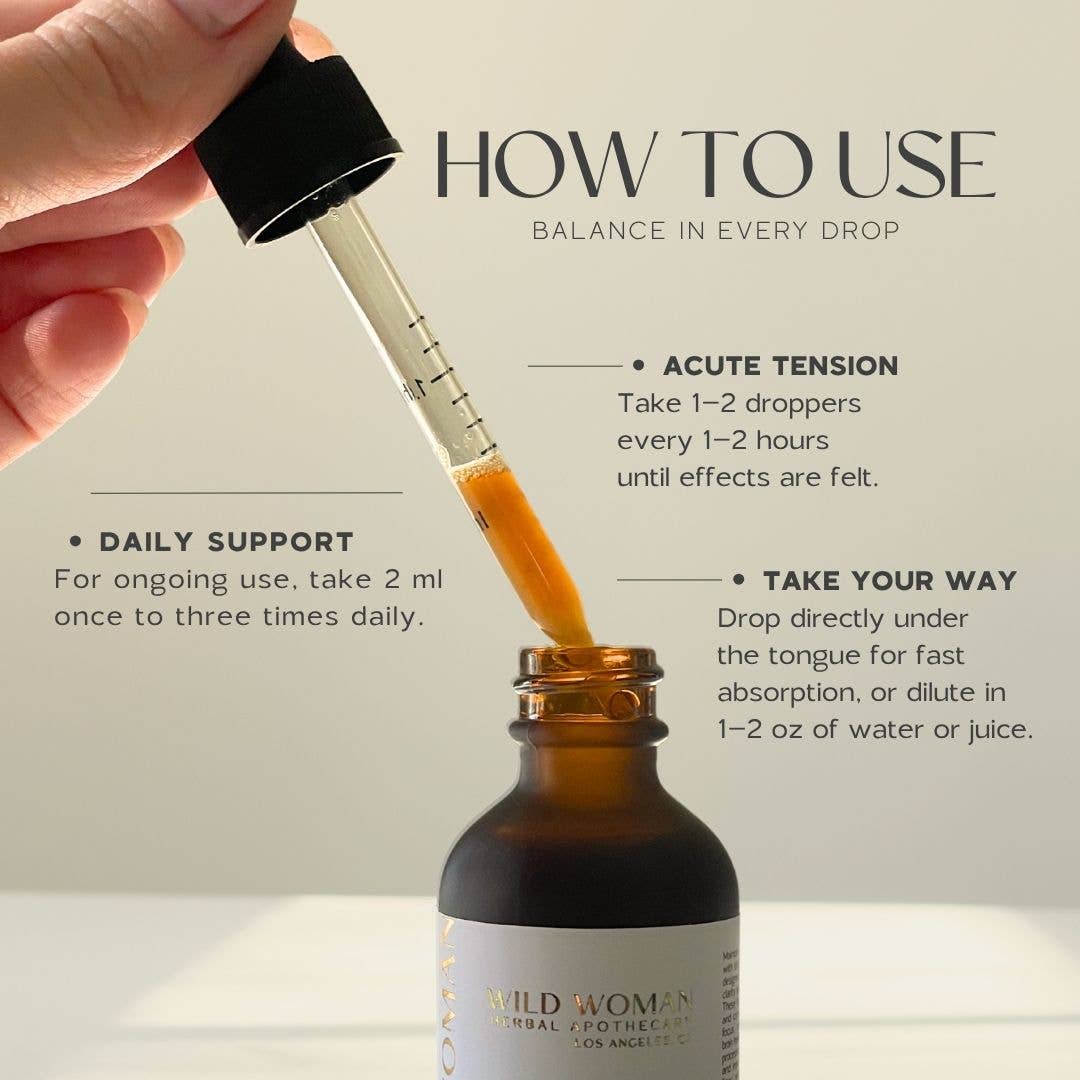
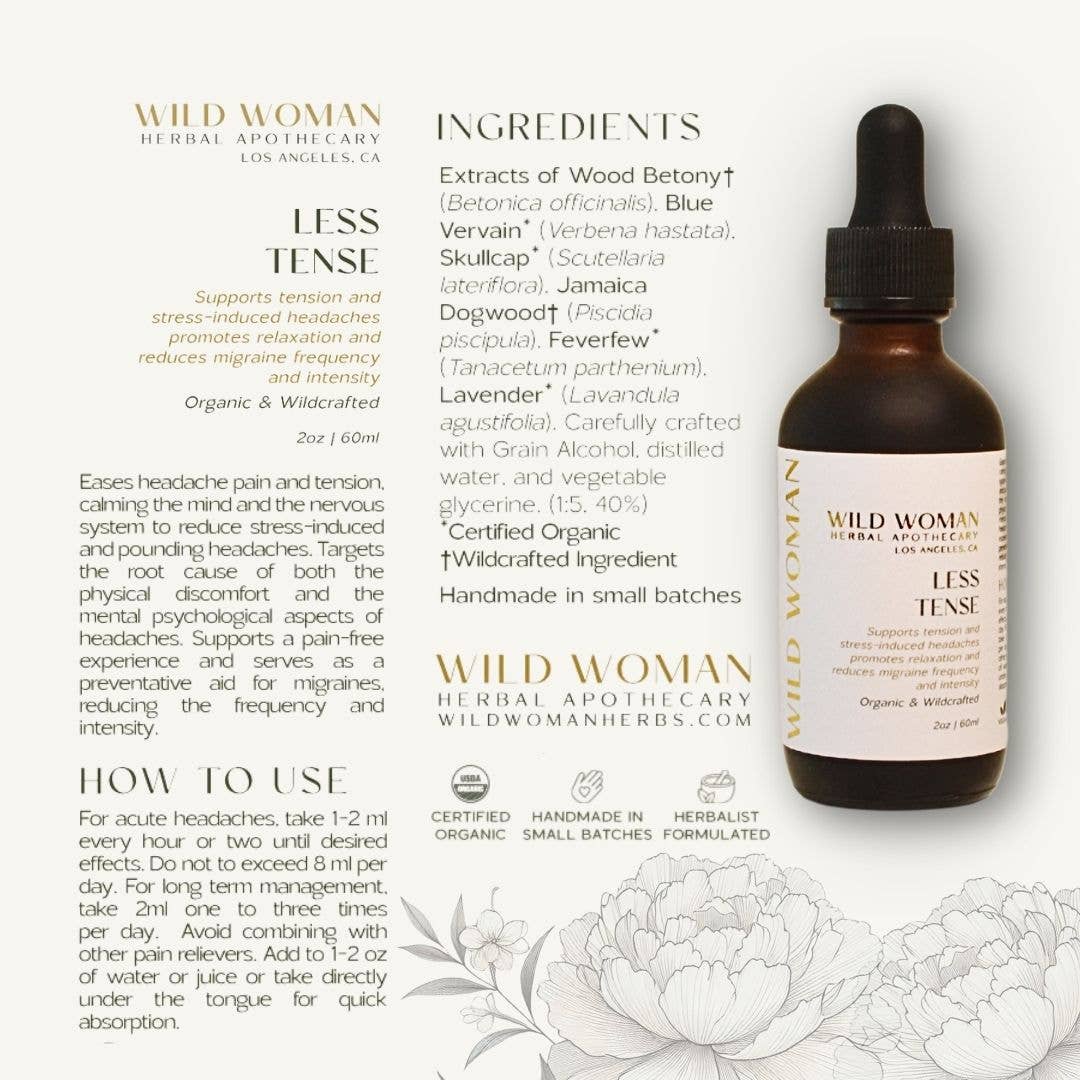
Shake gently before use. Take 30 drops directly under the tongue or in a small glass of water at the first sign of tension building in the head, neck, or jaw. A second dose 20 minutes later is welcome on the harder days. For consistent support during periods of frequent tension, take once or twice daily as part of a quieting practice. This is not a task. It is a signal to your nervous system that the emergency is over.
Wood Betony (Betonica officinalis) · Blue Vervain (Verbena hastata) · Skullcap (Scutellaria lateriflora) · Jamaican Dogwood (Piscidia piscipula) · Feverfew (Tanacetum parthenium) · Lavender (Lavandula angustifolia)
USDA Certified Organic sugarcane extract (40%) · USDA Certified Organic vegetable glycerin · Filtered water · Extraction ratio 1:5
All botanical ingredients are USDA Certified Organic or responsibly wildcrafted. Full plant profiles below.
The Plants
Wood Betony (Betonica officinalis) has been known in European herbal medicine for its particular affinity for the head: not just as a nervine, but as a plant that draws scattered energy downward, quieting the kind of mental heat that turns into pressure behind the eyes. It is where this formula begins, and everything that follows is built around its grounding intelligence.
Blue Vervain (Verbena hastata) works where tension is held above the shoulders, in the jaw, the upper trapezius, the back of the neck where stress gathers and stays. Skullcap (Scutellaria lateriflora) brings a deeper quieting, supporting the nervous system's capacity to loosen its grip on muscles that have been braced against a long and demanding day. Jamaican Dogwood (Piscidia piscipula) moves into the body's deeper holding, traditionally used in small amounts to support muscular ease in the head and neck when tension has rooted itself more persistently.
Feverfew (Tanacetum parthenium) carries centuries of use in Western herbal tradition to support the body during periods of head tension and migraine. Lavender (Lavandula angustifolia) finishes the formula as it does the day: aromatic, grounding, and steady, supporting nervous system ease in the body that has been carrying too much for too long.
This is a formula for the overstretched day. For screen fatigue and mental strain. For the tension that builds before you notice it and announces itself somewhere behind your eyes. Reach for it at the first sign of gathering pressure: under the tongue, a small glass of water, a moment to breathe.
The Lineage
Every plant in this formula was chosen from knowledge: not from a catalog, but from years of working with these specific botanicals and understanding what they ask of the body and what they offer it in return. The herbs are USDA Certified Organic or responsibly wildcrafted, extracted in small batches using organic sugarcane extract and organic vegetable glycerin at a 1:5 ratio. Nothing about this formula was rushed. The plants were not.
The Practice
Shake gently before use. Take 30 drops directly under the tongue or in a small glass of water at the first sign of tension building in the head, neck, or jaw. A second dose 20 minutes later is welcome on the harder days. For consistent support during periods of frequent tension, take once or twice daily as part of a quieting practice. This is not a task. It is a signal to your nervous system that the emergency is over.
The Formula
Wood Betony (Betonica officinalis) · Blue Vervain (Verbena hastata) · Skullcap (Scutellaria lateriflora) · Jamaican Dogwood (Piscidia piscipula) · Feverfew (Tanacetum parthenium) · Lavender (Lavandula angustifolia)
USDA Certified Organic sugarcane extract (40%) · USDA Certified Organic vegetable glycerin · Filtered water · Extraction ratio 1:5
All botanical ingredients are USDA Certified Organic or responsibly wildcrafted. Full plant profiles below.

Ritual Moment
mid-day · at the first sign of tension · the long afternoon

Tasting Notes
bitter · green and herbal · faintly floral · clean and grounding

Pairs With
hydration · a closed door · breathwork · a few minutes outside

Energetics
softening · releasing
Ritual Moment
mid-day · at the first sign of tension · the long afternoon
Tasting Notes
bitter · green and herbal · faintly floral · clean and grounding
Pairs With
hydration · a closed door · breathwork · a few minutes outside
Energetics
softening · releasing
Wood Betony
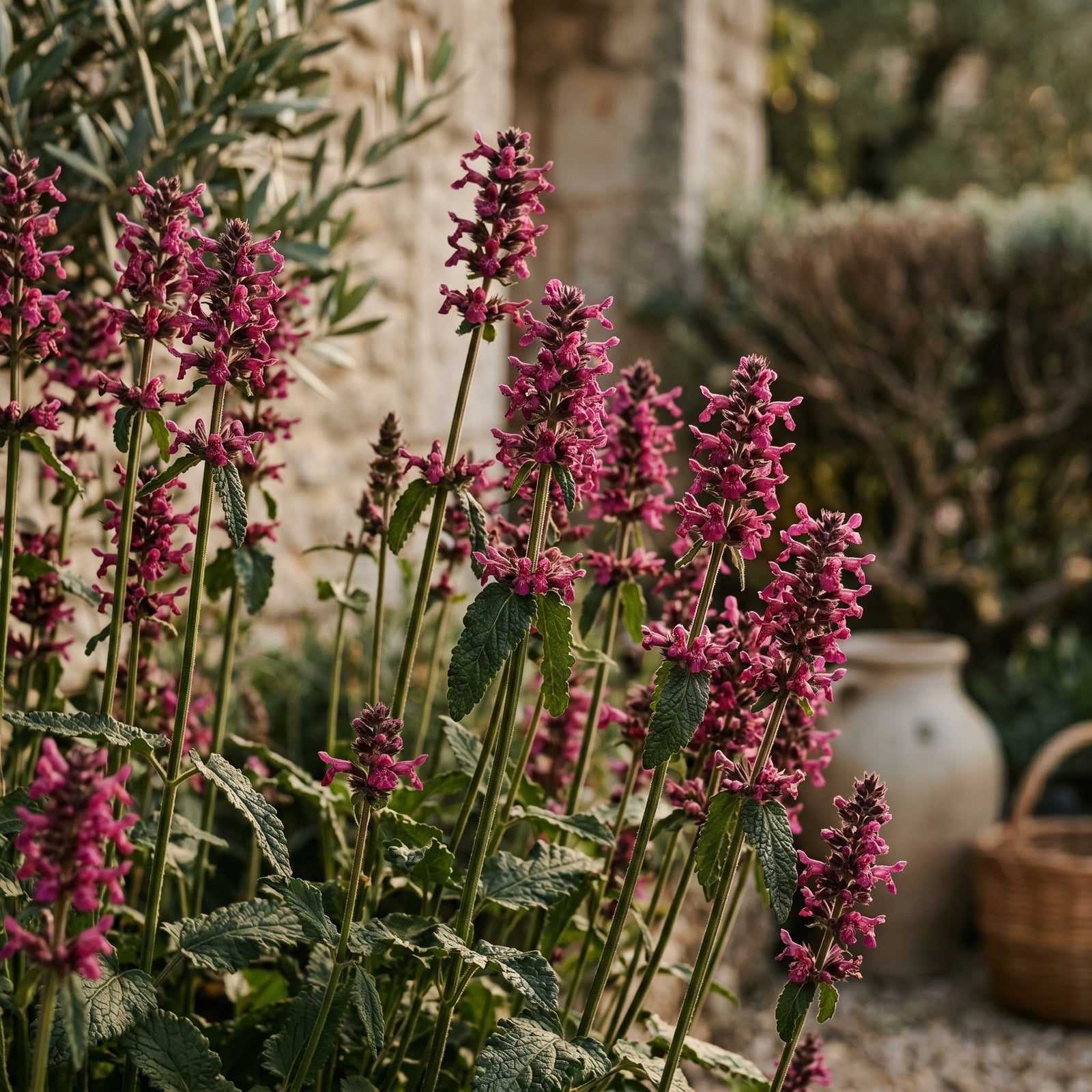
Wood Betony is one of the oldest medicinal herbs in the European record, documented by Dioscorides in the first century, tended in monastery gardens across the Middle Ages, prized by Anglo-Saxon healers who considered it a remedy for nearly any affliction of the head. That breadth of use is, in its way, a kind of precision: Wood Betony has a particular affinity for what happens when the mind runs too fast and too hot, when scattered energy pools in the skull and turns into pressure. It has a downward-drawing quality that herbalists have described across traditions, drawing heat and tension out of the head, supporting circulation to the area in a way that invites release rather than forcing it.
There is a reason it grows so quietly, in dry meadows and at the edges of forests, easy to overlook. It is not a dramatic plant. Neither is its medicine. It works with the body's own intelligence, gradually, without insisting. One sip of a Wood Betony infusion, and most practitioners will tell you they felt their shoulders lower. That is where it begins.
Blue Vervain
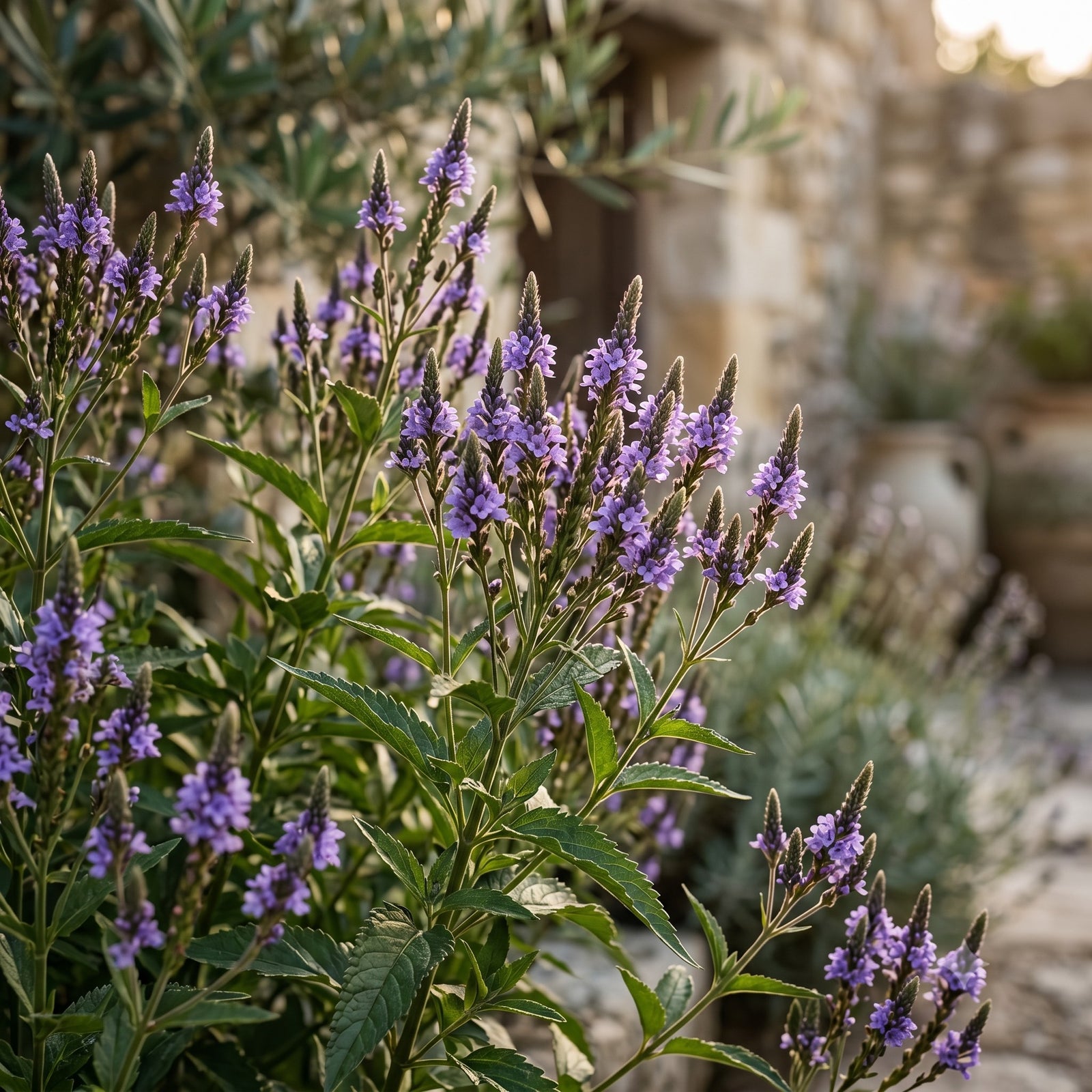
Herbalists have long understood that Blue Vervain is a plant for a specific kind of person: the one who holds impossibly high standards, who gives more than the body can sustain, who lives with tension gathered above the shoulders like a permanent weather system. Matthew Wood, one of the great contemporary Western herbalists, calls it a plant for the overworked and the unwilling to rest. The classic indication is jaw tightness, upper neck tension, the phenomenon herbalists sometimes describe as wearing your shoulders like earrings. If that phrase recognizes you, so might this plant.
Blue Vervain (Verbena hastata) is a nervine relaxant and antispasmodic. It works both on the nervous system and on the musculature that the nervous system controls. It was used in North American and European traditions as a bitter tonic and a plant for cooling tension held in the upper body and head. It is bitter enough, in fact, that it is best taken in tincture form: its medicine arrives quickly through sublingual absorption, before the body braces against what's coming.
Jamaican Dogwood
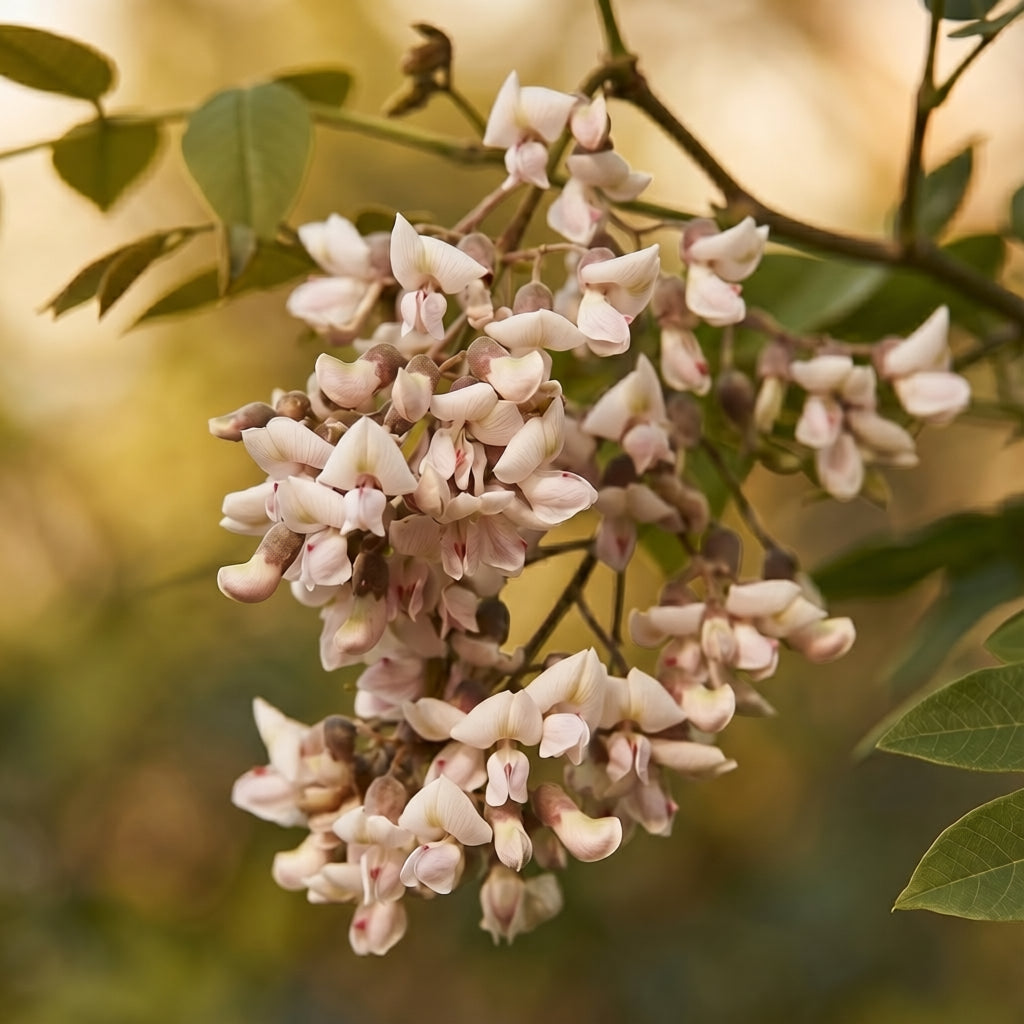
Jamaican Dogwood grows at the edges of things: coastlines, riverbanks, the boundaries between salt water and dry land in the Caribbean and Gulf Coast regions where it has been used in traditional medicine for centuries. It is not a gentle plant. It is one of the more potent botanicals in the Western herbal materia medica, historically used by fishermen who understood its capacity to act powerfully on the body, and by herbalists who learned to work with it carefully, in small amounts, for the specific kind of physical tension that does not respond to gentler approaches.
In the herbal tradition, Jamaican Dogwood (Piscidia piscipula) has been used as a nervine and antispasmodic with particular relevance for pain rooted in muscular tension and nervous system overactivation: the kind of deep, persistent holding in the head, neck, and shoulders that has been building since morning and has stopped responding to anything softer. It is traditionally understood as a plant that supports the body's ease during periods of significant physical tension, working at a level that the nervines alone cannot always reach. In this formula it plays a specific and irreplaceable role: not as a background herb, but as the plant that goes where the others have prepared the ground. It is used here in the small, careful amounts the tradition requires, within a formula designed to honor both its potency and its intelligence.
Skullcap
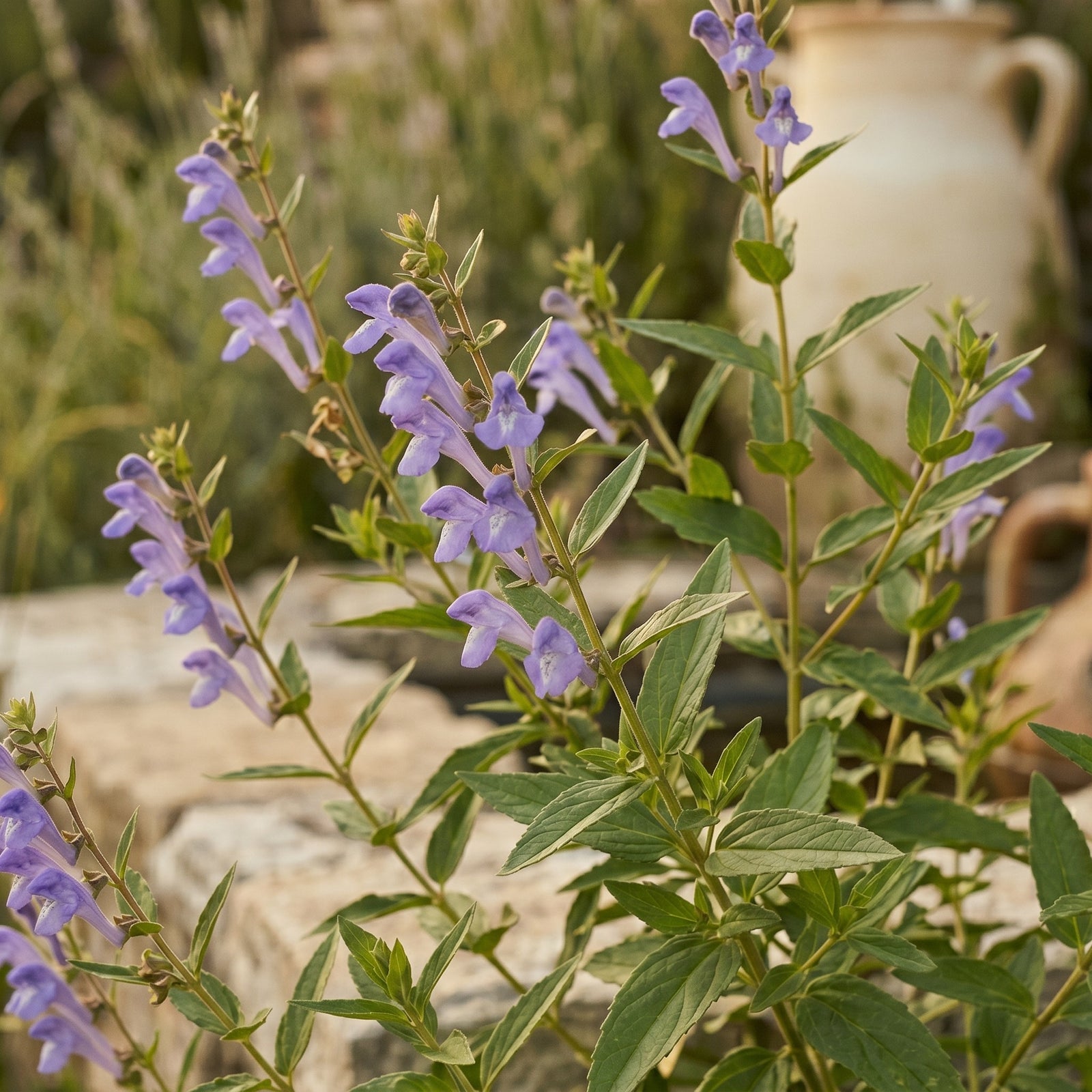
Skullcap has been a trusted nervine in the North American herbal tradition for centuries, used by indigenous peoples of the eastern woodlands long before it entered European herbal practice, and valued since for its capacity to quiet the nervous system without sedating it. What Skullcap offers is not sleep or heaviness. It is the release of muscular bracing: the particular tightening that happens when the nervous system has been on alert too long and the muscles have begun to follow.
In this formula, Skullcap (Scutellaria lateriflora) works specifically on the place where tension gathers when the day has been too long and too loud: the jaw, the shoulders, the base of the skull. It quiets the nervous system's grip on those muscles, supporting the kind of softening that allows the head to release what it has been holding. It is a plant that knows the difference between an emergency and a long Tuesday, and it helps the body learn that difference too.
Wood Betony
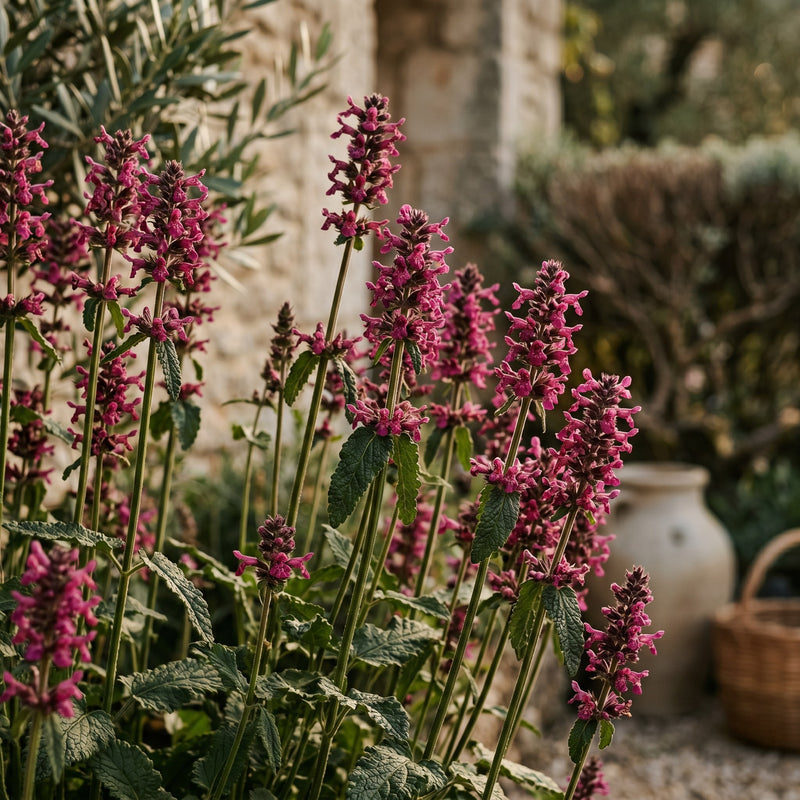
Wood Betony is one of the oldest medicinal herbs in the European record, documented by Dioscorides in the first century, tended in monastery gardens across the Middle Ages, prized by Anglo-Saxon healers who considered it a remedy for nearly any affliction of the head. That breadth of use is, in its way, a kind of precision: Wood Betony has a particular affinity for what happens when the mind runs too fast and too hot, when scattered energy pools in the skull and turns into pressure. It has a downward-drawing quality that herbalists have described across traditions, drawing heat and tension out of the head, supporting circulation to the area in a way that invites release rather than forcing it.
There is a reason it grows so quietly, in dry meadows and at the edges of forests, easy to overlook. It is not a dramatic plant. Neither is its medicine. It works with the body's own intelligence, gradually, without insisting. One sip of a Wood Betony infusion, and most practitioners will tell you they felt their shoulders lower. That is where it begins.
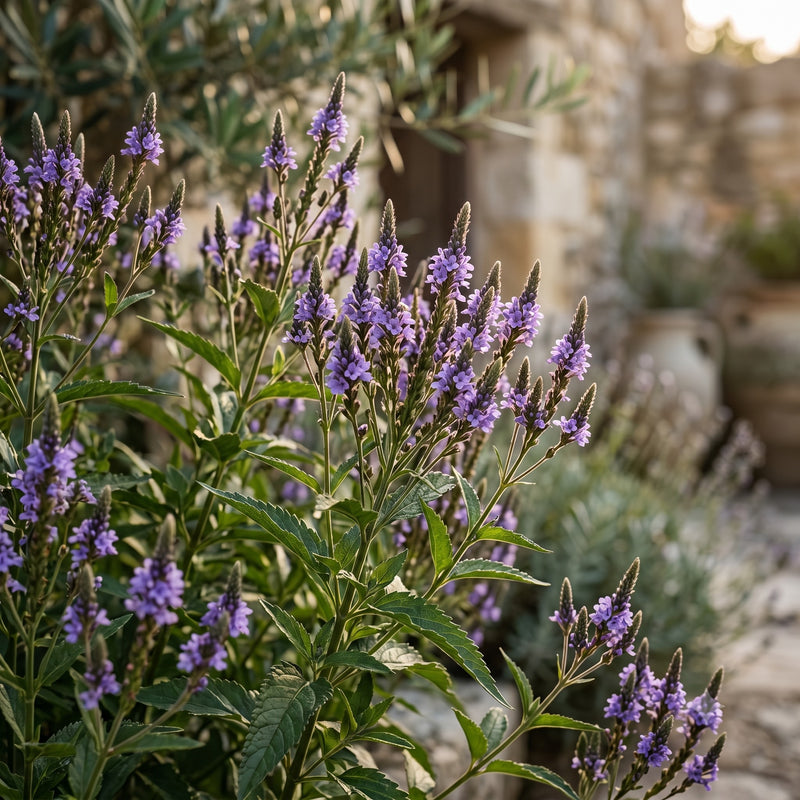
Blue Vervain
Herbalists have long understood that Blue Vervain is a plant for a specific kind of person: the one who holds impossibly high standards, who gives more than the body can sustain, who lives with tension gathered above the shoulders like a permanent weather system. Matthew Wood, one of the great contemporary Western herbalists, calls it a plant for the overworked and the unwilling to rest. The classic indication is jaw tightness, upper neck tension, the phenomenon herbalists sometimes describe as wearing your shoulders like earrings. If that phrase recognizes you, so might this plant.
Blue Vervain (Verbena hastata) is a nervine relaxant and antispasmodic. It works both on the nervous system and on the musculature that the nervous system controls. It was used in North American and European traditions as a bitter tonic and a plant for cooling tension held in the upper body and head. It is bitter enough, in fact, that it is best taken in tincture form: its medicine arrives quickly through sublingual absorption, before the body braces against what's coming.
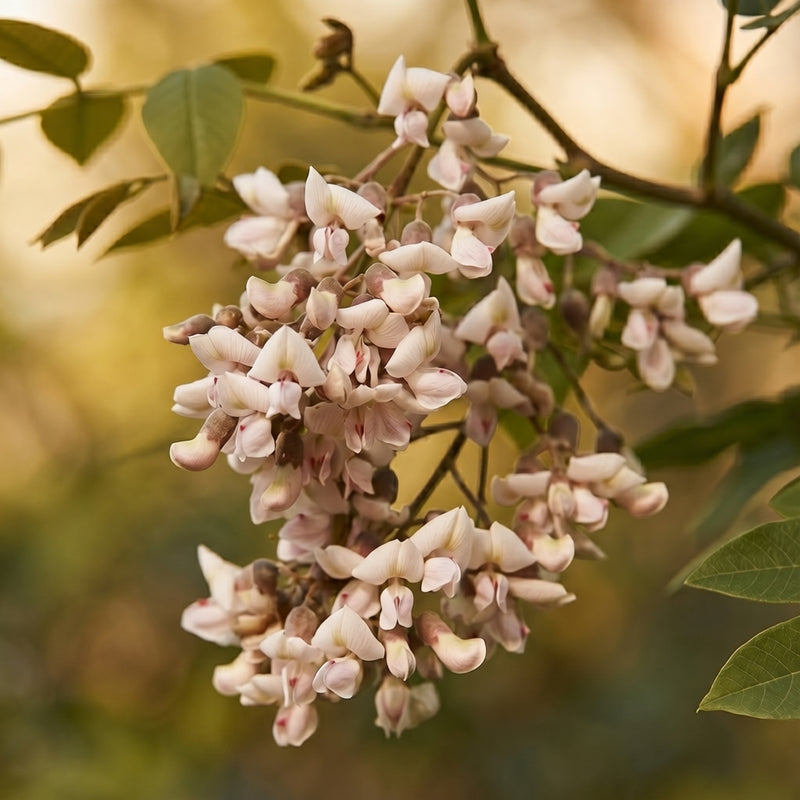
Jamaican Dogwood
Jamaican Dogwood grows at the edges of things: coastlines, riverbanks, the boundaries between salt water and dry land in the Caribbean and Gulf Coast regions where it has been used in traditional medicine for centuries. It is not a gentle plant. It is one of the more potent botanicals in the Western herbal materia medica, historically used by fishermen who understood its capacity to act powerfully on the body, and by herbalists who learned to work with it carefully, in small amounts, for the specific kind of physical tension that does not respond to gentler approaches.
In the herbal tradition, Jamaican Dogwood (Piscidia piscipula) has been used as a nervine and antispasmodic with particular relevance for pain rooted in muscular tension and nervous system overactivation: the kind of deep, persistent holding in the head, neck, and shoulders that has been building since morning and has stopped responding to anything softer. It is traditionally understood as a plant that supports the body's ease during periods of significant physical tension, working at a level that the nervines alone cannot always reach. In this formula it plays a specific and irreplaceable role: not as a background herb, but as the plant that goes where the others have prepared the ground. It is used here in the small, careful amounts the tradition requires, within a formula designed to honor both its potency and its intelligence.
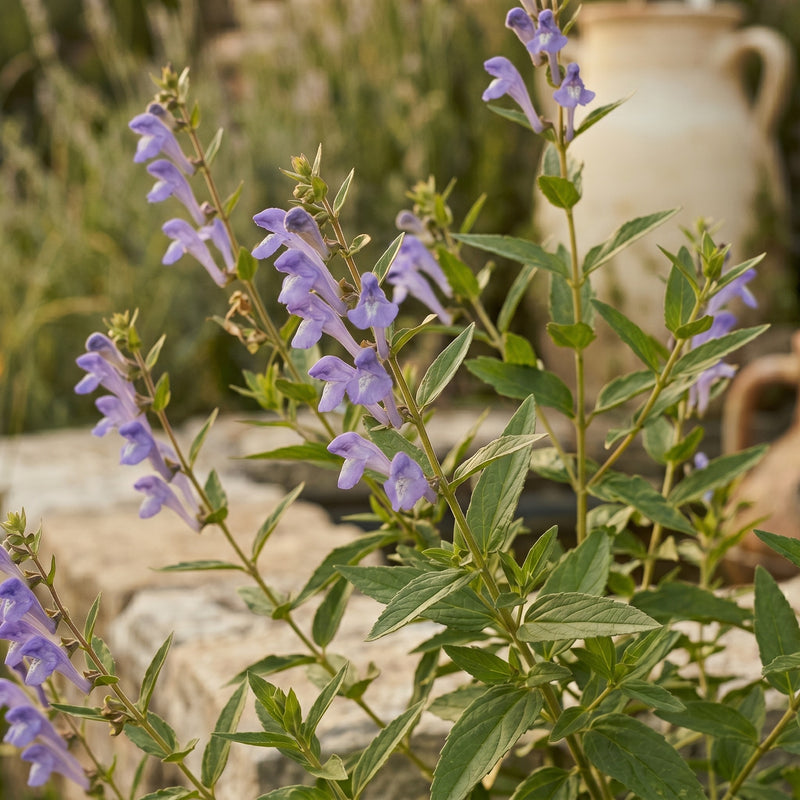
Skullcap
Skullcap has been a trusted nervine in the North American herbal tradition for centuries, used by indigenous peoples of the eastern woodlands long before it entered European herbal practice, and valued since for its capacity to quiet the nervous system without sedating it. What Skullcap offers is not sleep or heaviness. It is the release of muscular bracing: the particular tightening that happens when the nervous system has been on alert too long and the muscles have begun to follow.
In this formula, Skullcap (Scutellaria lateriflora) works specifically on the place where tension gathers when the day has been too long and too loud: the jaw, the shoulders, the base of the skull. It quiets the nervous system's grip on those muscles, supporting the kind of softening that allows the head to release what it has been holding. It is a plant that knows the difference between an emergency and a long Tuesday, and it helps the body learn that difference too.

Jasmine's Note
I didn't fully understand what I'd inherited until my own body started asking questions that medicine couldn't answer. Hormonal chaos, long seasons of depression, the particular exhaustion of feeling disconnected from yourself. I remembered the whisperings. I turned back toward the plants. Everything in this apothecary came from that turning — things I made for myself first, and then for the women in my life who needed the same. I offer them to you the way my grandmother offered what she knew: as a hand extended, as something real.
-Jasmine
Rooted in Lineage. Made with Reverence.
This is medicine in the oldest sense of the word: plant wisdom, carefully tended, passed forward with care.
Frequently Asked Questions
What herbal remedies for headaches does this formula contain?
Less Tense is a small-batch herbal remedy for headaches and head-centered tension rooted in the Western herbal tradition. The formula brings together Wood Betony (Betonica officinalis), Blue Vervain (Verbena hastata), Skullcap (Scutellaria lateriflora), Jamaican Dogwood (Piscidia piscipula), Feverfew (Tanacetum parthenium), and Lavender (Lavandula angustifolia): six plants that have been traditionally used across centuries of European and North American herbalism to support the body's release of tension in the head, neck, and shoulders. These plants work through the nervous system and the musculature it governs, supporting ease and softening where stress tends to hold most tightly. This is not a pharmaceutical approach. It is plant wisdom, prepared carefully and offered in the same spirit in which herbalists have worked with these botanicals for generations.
Can this tincture be used as a natural remedy for tension headaches and migraines?
Less Tense was formulated with both tension headaches and migraines in mind, drawing on plants that have been traditionally used as natural remedies for tension headaches across the herbal record. Feverfew (Tanacetum parthenium) has one of the longest documented histories of use for head tension and migraine support in Western herbalism. Wood Betony (Betonica officinalis), with its particular affinity for the head and its downward-drawing quality, has been used in European herbalism since the first century for exactly this kind of tension. Jamaican Dogwood (Piscidia piscipula) brings a deeper dimension to the formula: traditionally used as an herbal analgesic and antispasmodic, it supports the body's ease during periods of significant physical tension that has rooted itself in the head, neck, and jaw. This formula is not a medical treatment. It is a plant-based practice rooted in a very long tradition of working with head-centered tension through the nervous system and the body's own capacity for ease. Many customers reach for it at the first sign of tension building, before it arrives fully, and find that the early-use window is when the plants work best.
What is Wood Betony, and why is it in this formula?
Wood Betony (Betonica officinalis) is a European herb with one of the longest and most specific traditions of use for head-centered tension in the herbal record. Documented by Dioscorides in the first century and cultivated in monastery gardens across medieval Europe, it was considered by Anglo-Saxon herbalists to be among the most important plants for conditions of the head and nervous system. In contemporary Western herbalism, Wood Betony is understood to have a downward-drawing quality: it supports circulation to the head in a way that invites the release of accumulated tension rather than forcing it, and it is particularly well suited to the kind of mental heat that turns into head pressure after long periods of focus or stress. In this formula, it is the foundational plant, the one around which everything else was built. There is nothing else quite like it in the materia medica for this specific purpose, which is why it leads the formula rather than supporting it.
Is this safe to use with other medications, or during pregnancy and breastfeeding?
We always recommend checking with your healthcare provider before beginning any new herbal practice, especially if you are pregnant, breastfeeding, taking prescription medications, or managing an ongoing health condition. Jamaican Dogwood (Piscidia piscipula) and Blue Vervain (Verbena hastata) in particular have traditional contraindications in pregnancy and are not recommended without professional guidance during that time. This formula contains organic sugarcane extract as the extraction base. If you are avoiding alcohol for any reason, please factor that in. Jasmine is an herbalist, not a prescriber. She offers this formula as plant knowledge and invites you to bring it into conversation with any other care you are receiving.
How quickly does Less Tense work, and how should I use it?
The formula is designed for sublingual absorption: taking it directly under the tongue allows the botanicals to enter the bloodstream more quickly than a capsule or tea would. Many customers notice a shift within 15 to 30 minutes. The formula works best when you reach for it at the first sign of tension building rather than waiting until it has fully arrived. Wood Betony and Blue Vervain in particular respond to that early window. Take 30 drops under the tongue or in a small glass of water. A second dose 20 minutes later is appropriate on the harder days. For those who experience frequent tension during periods of high stress or extended screen time, taking Less Tense once or twice daily during those stretches offers more consistent support than acute use alone.
How is this different from ibuprofen or over-the-counter options?
This formula does not work the way ibuprofen works. Ibuprofen targets a specific physiological mechanism and is a pharmaceutical intervention. Less Tense works through the nervous system and the musculature that the nervous system governs, using plants that have been traditionally used to support the body's own capacity for releasing held tension. It is plant-based support for headaches without ibuprofen: a different mode of working with the body, not a replacement for it. Some people use both. Some people reach for Less Tense first and find they need nothing else. What we can say honestly is that the plants in this formula have a centuries-long tradition of use for head tension, and that a significant number of customers have made it a consistent household practice, including people who previously relied primarily on over-the-counter options. Jasmine offers it not as a claim but as an invitation: try the plants. See what your body says.
What does Blue Vervain do for neck and jaw tension?
Blue Vervain (Verbena hastata) has a well-established tradition in both North American and European herbalism for the specific kind of tension that lives above the shoulders. Herbalists have long understood it as a plant for the person who holds stress in the jaw and upper neck: what Matthew Wood, one of the contemporary masters of Western herbalism, describes as the person who wears their shoulders like earrings. It functions as a nervine relaxant and antispasmodic, working both on the nervous system and on the muscles the nervous system controls. In practice, this means it addresses the physical dimension of tension headaches rooted in jaw clenching, neck tightness, and upper-body bracing: the kind of tension that accumulates through long workdays, screen exposure, and sustained mental effort. Because it is intensely bitter, it is best taken in tincture form, where sublingual absorption allows it to work quickly.
A Note on Plant Medicine
Plants are powerful — and like any potent thing, they deserve to be used with care and knowledge. These formulas are crafted with intention, but they are not a substitute for medical guidance. Before beginning a new herbal practice, we encourage you to speak with your healthcare provider, especially if you are pregnant, nursing, trying to conceive, managing a health condition, or taking prescription medication. Wild Woman products are not intended to diagnose, treat, cure, or prevent any disease.
Stay close to the apothecary
THE LETTER
Herbal rituals for every season of womanhood
Sent four times a year, when the season turns. Plant wisdom, slow writing, and occasional notes from the bench. No promotions, no urgency.

SMALL BATCH
Made by hand in our Los Angeles apothecary

WILDCRAFTED & ORGANIC
Herbs gathered seasonally or grown by farmers we trust

CRAFTED SLOWLY
Each formula prepared without rushing for scale

ROOTED IN LINEAGE
In the tradition of the women who have come before us