

Moon Cycle Support Tea
natural care for pms & menstrual discomfort
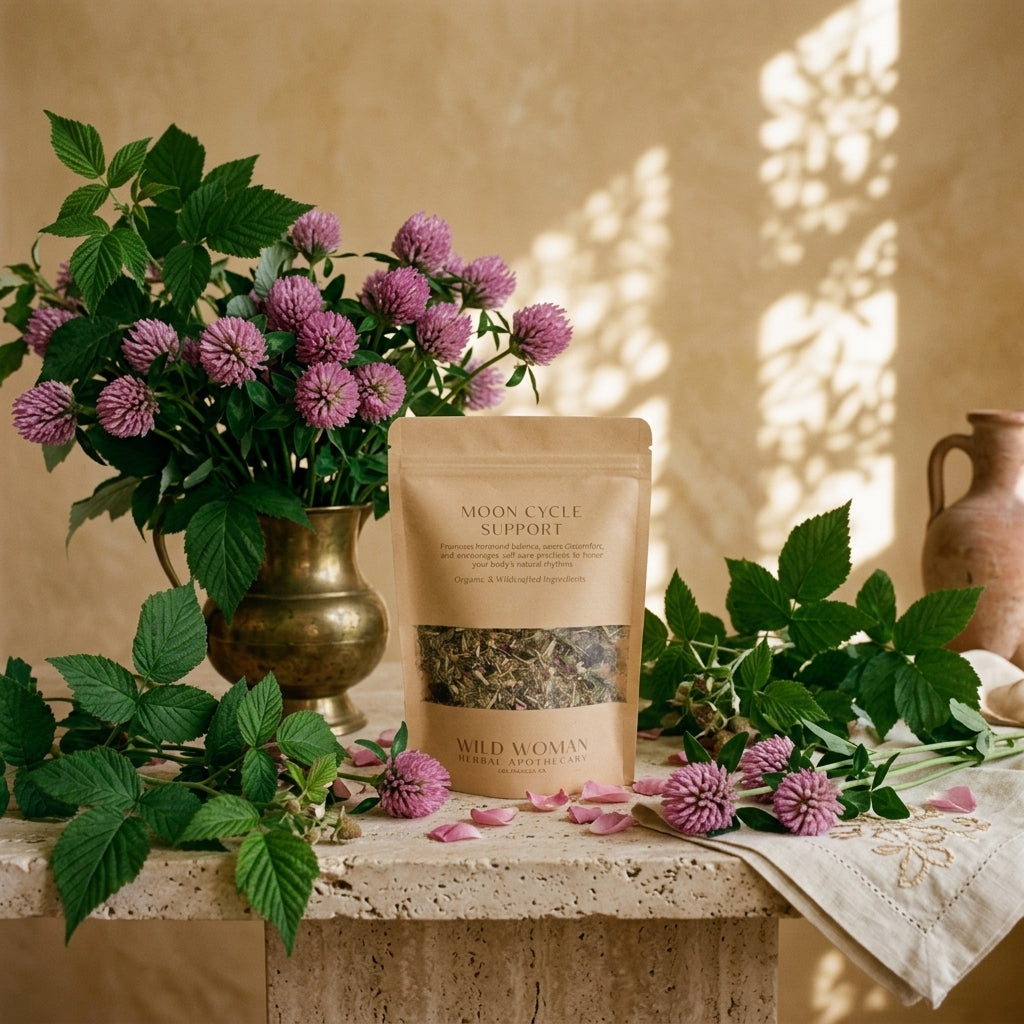
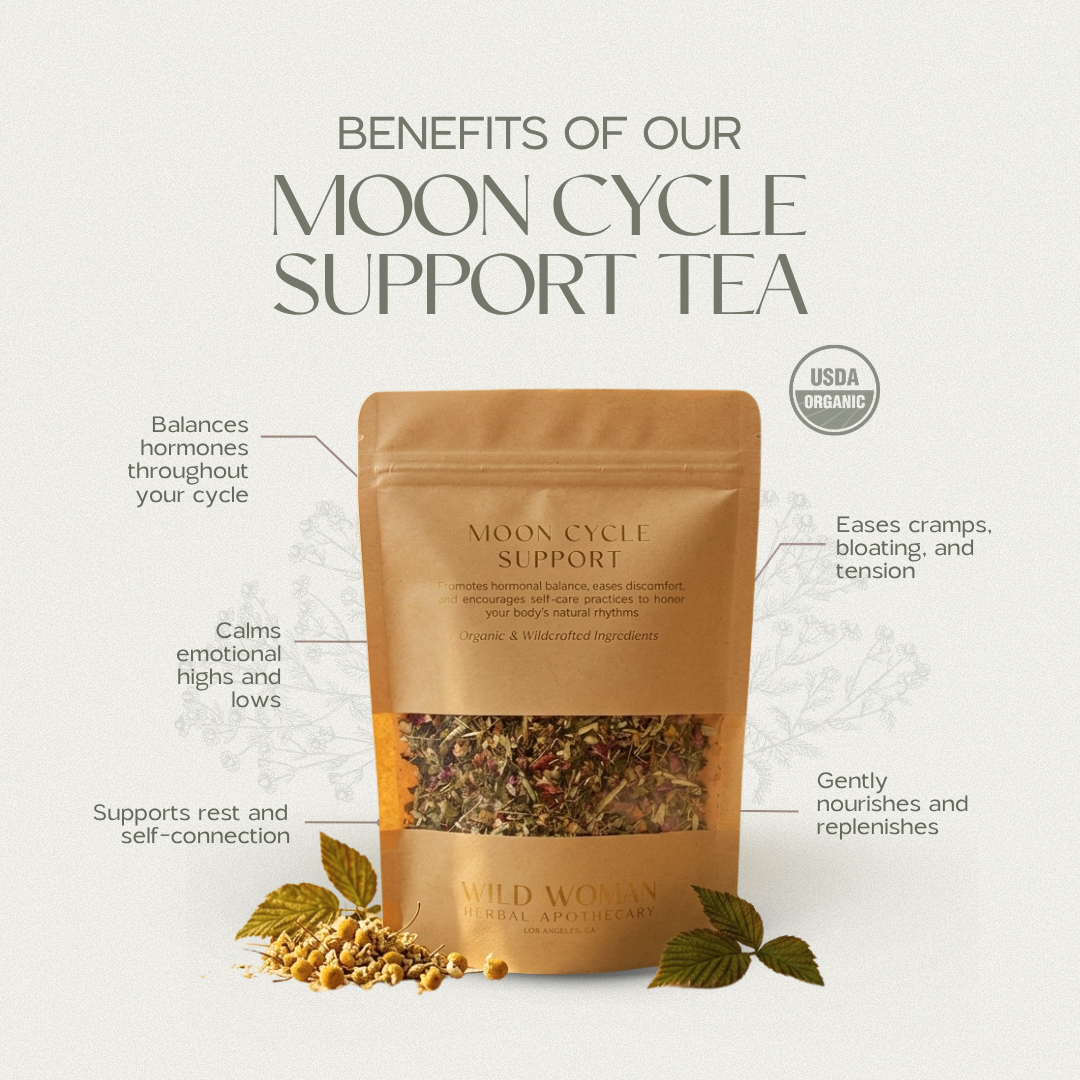
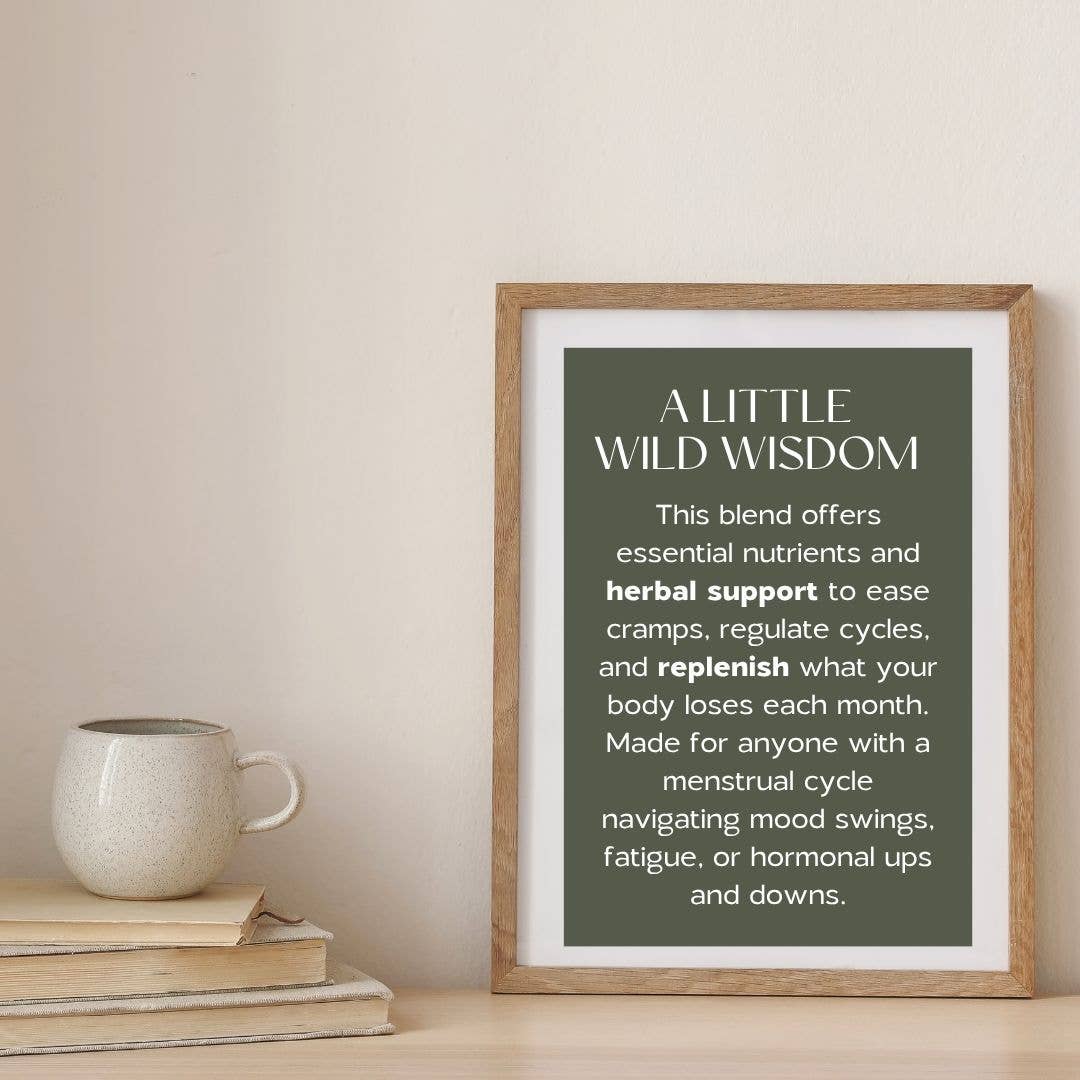
Moon Cycle Support is an herbal tea for menstrual support, nine organic and wildcrafted botanicals blended for the woman who knows that her cycle asks for nourishment, not endurance. Raspberry Leaf, Lemon Balm, and Rose tend the emotional body through its most sensitive season. Nettle and Oat Straw bring the mineral depth the bleeding time quietly asks to have returned.
soft · floral · gently minty · warm · still

Choose options


Moon Cycle Tea
PRODUCT DETAILS
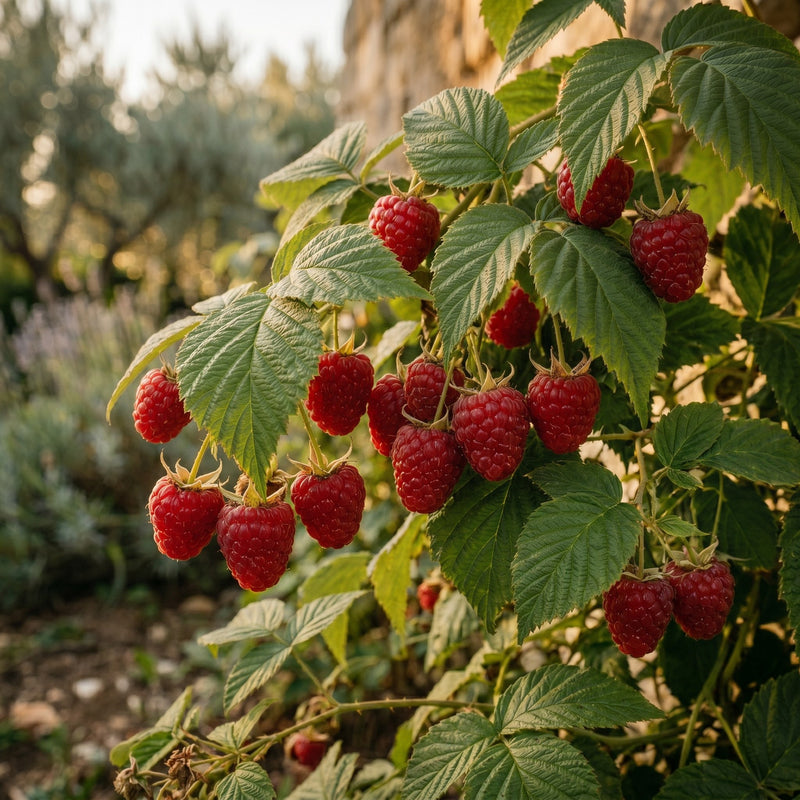
Raspberry Leaf (Rubus idaeus) has been in women's cups for longer than most of us can trace — not because anyone prescribed it, but because women found it and kept finding it, dried it, steeped it, passed it forward. It is a mineral-rich herb that gives something back to the body during the time of greatest release. That is where this formula begins: with the understanding that the menstrual phase is a time of giving out, and that the plants gathered here are ones that give back.
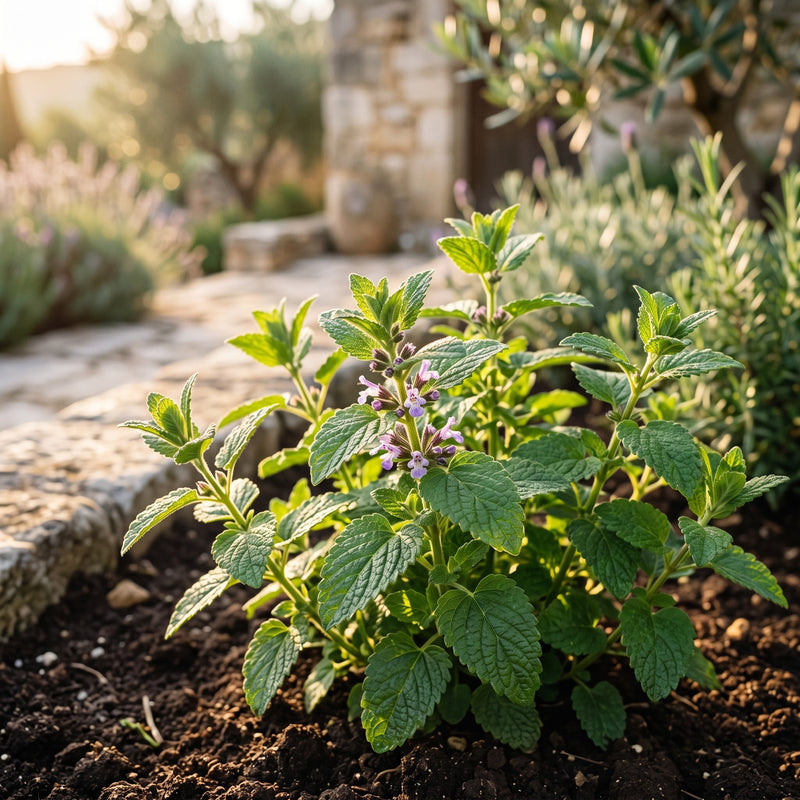
Lemon Balm (Melissa officinalis) and Linden Flower (Tilia cordata) tend to the emotional body. The menstrual phase can arrive with a particular kind of sensitivity — a thinning of the membrane between inner and outer that can feel like overwhelm before it finds its deeper intelligence. These are the herbs that soften that threshold, that support the nervous system in staying warm and present rather than bracing against itself. The blend would not be the same without them.
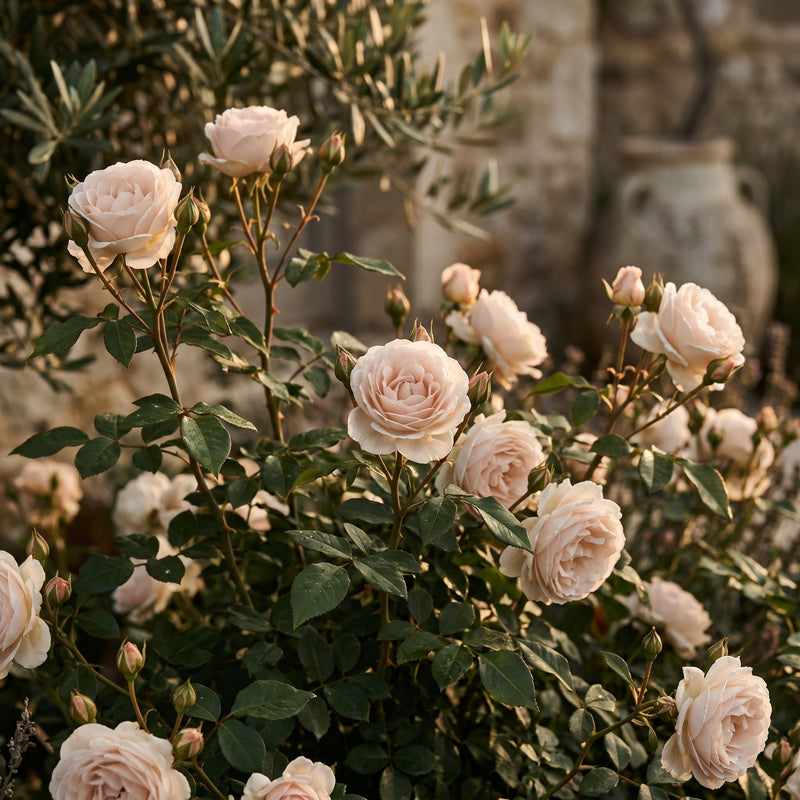
Rose Petals (Rosa spp.) are not here for decoration. Rose has a long tradition in women's plant medicine as a heart-softening botanical — gentle and belonging to the emotional body more than the physical one. In this formula she holds the center, the way a slow breath holds a difficult moment. She is the reason this tea asks something of you before you drink it: a pause, a reception, a willingness to soften.
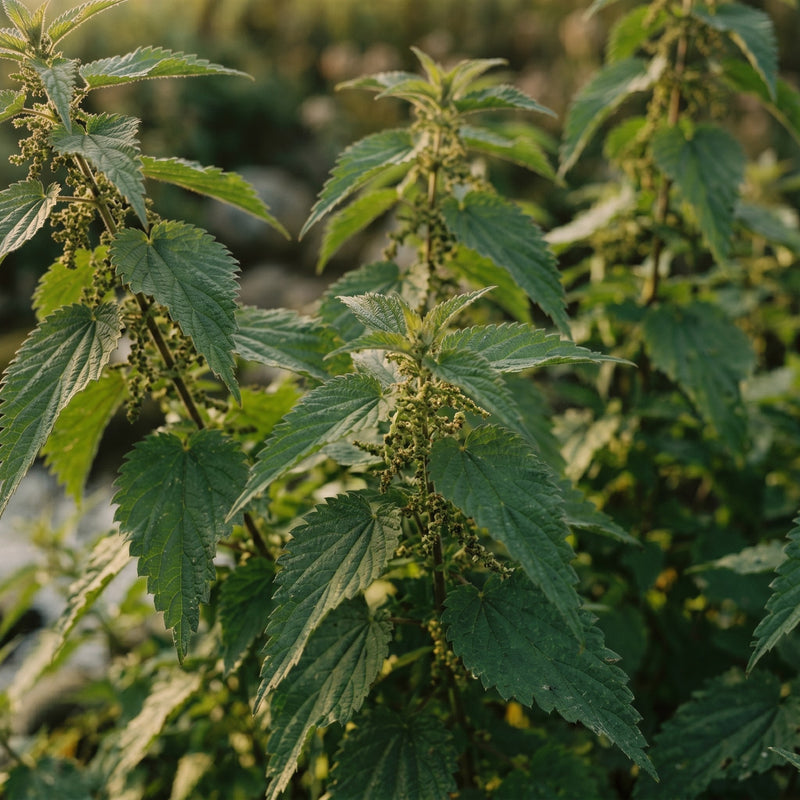
Nettle Leaf (Urtica dioica) and Oat Straw (Avena sativa) bring the mineral foundation. The body's need for nourishment during the menstrual phase is real and often unmet. These two herbs, rooted in the nourishing infusion tradition, quietly tend to that depletion without performance. Peppermint (Mentha piperita) brightens the blend and supports the gentleness of digestion. Red Clover (Trifolium pratense) adds a soft sweetness and whole-body nourishment. Chamomile (Matricaria chamomilla) closes the circle with its steady, quiet calm. Together these nine plants form a complete portrait of what the menstrual body asks for — not as a course of treatment, but as a daily practice of remembering to receive.
Every herb in this blend was sourced the way it has always been sourced: with attention to season, to origin, and to what the plant is actually offering at the moment of harvest. The raspberry leaf, chamomile, and lemon balm are USDA Certified Organic. The rose petals, nettle, and oat straw are responsibly wildcrafted, gathered from places where they grow as they are meant to grow. Blended in small batches in Los Angeles. Nothing rushed. Nothing outsourced.
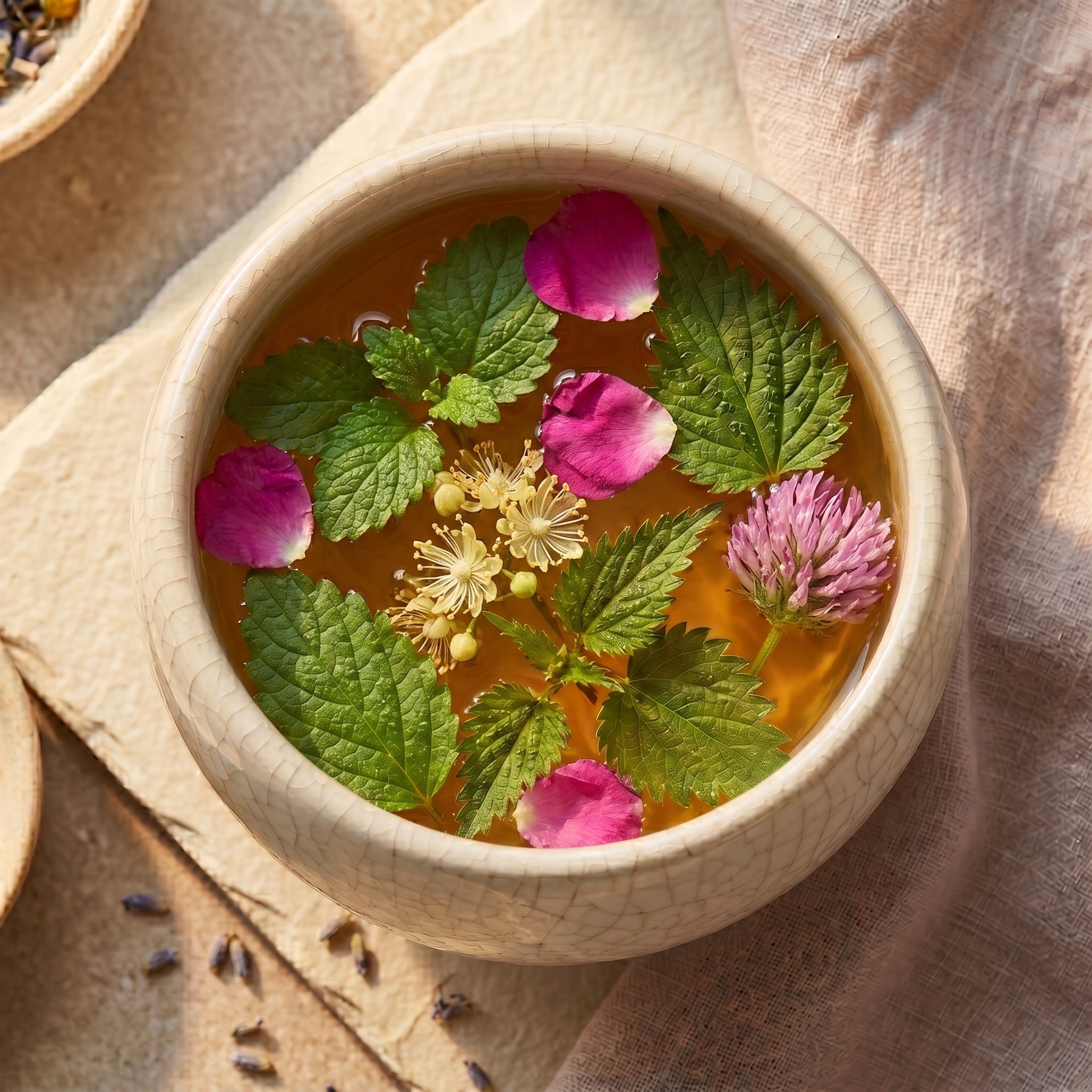
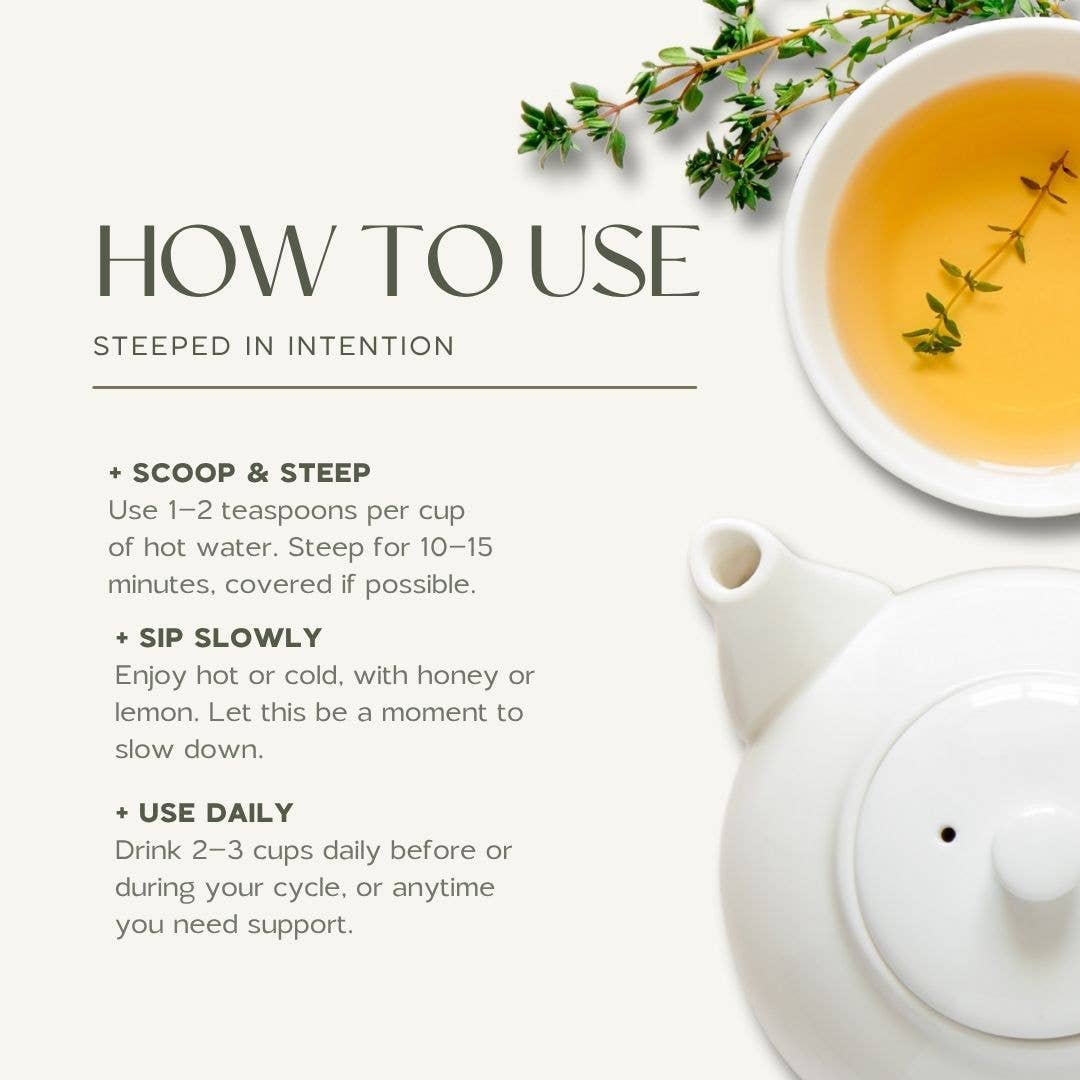
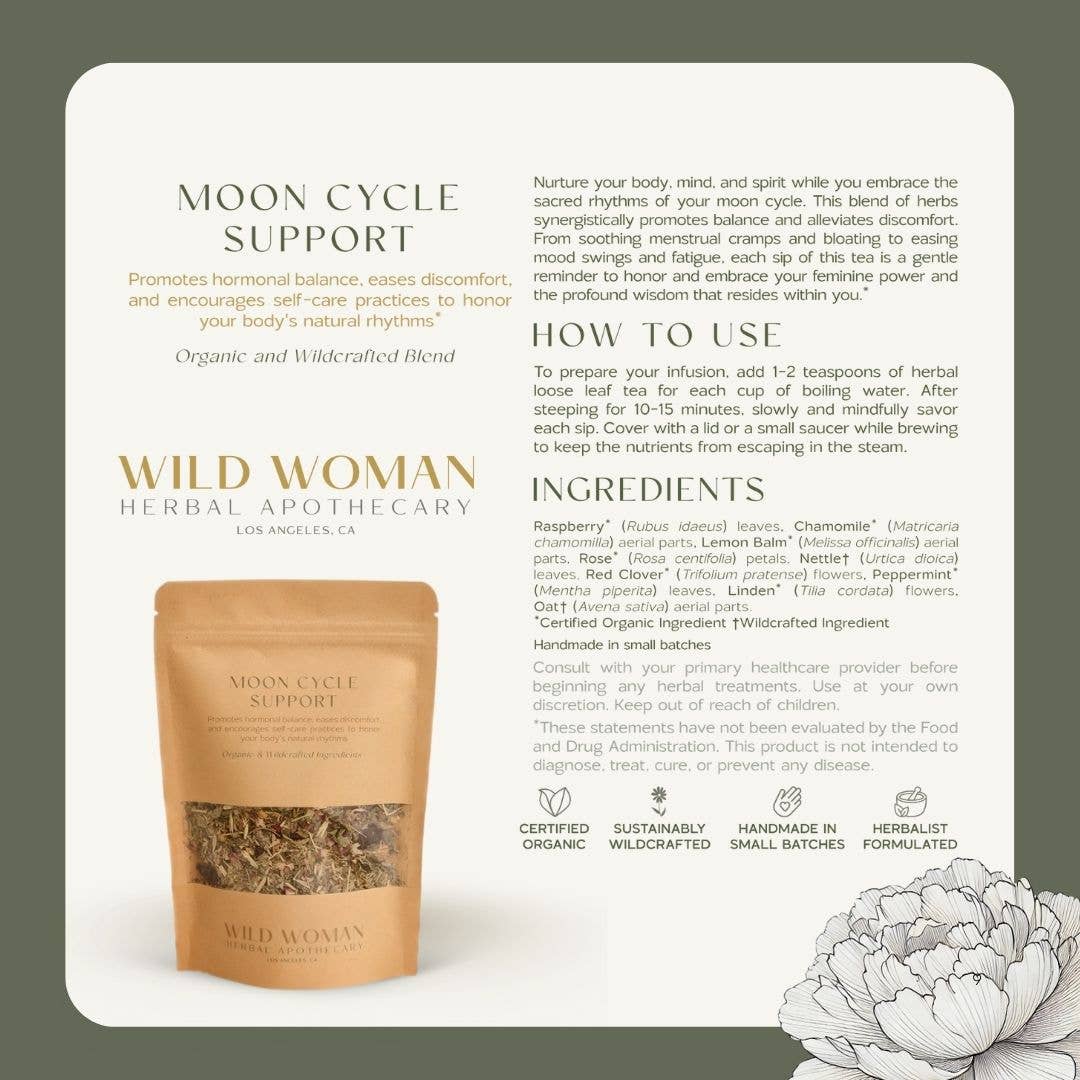
Bring fresh water to just below a boil and pour it over a heaping tablespoon of the blend. Let it steep, covered, for eight to ten minutes. Sip slowly, one to three cups throughout the day, beginning in the few days before bleeding and continuing through the menstrual phase. The cover matters: it holds the volatile oils that carry the plants' most delicate properties. This is not a tea to drink standing at the counter. It is a cup that asks you to sit down.
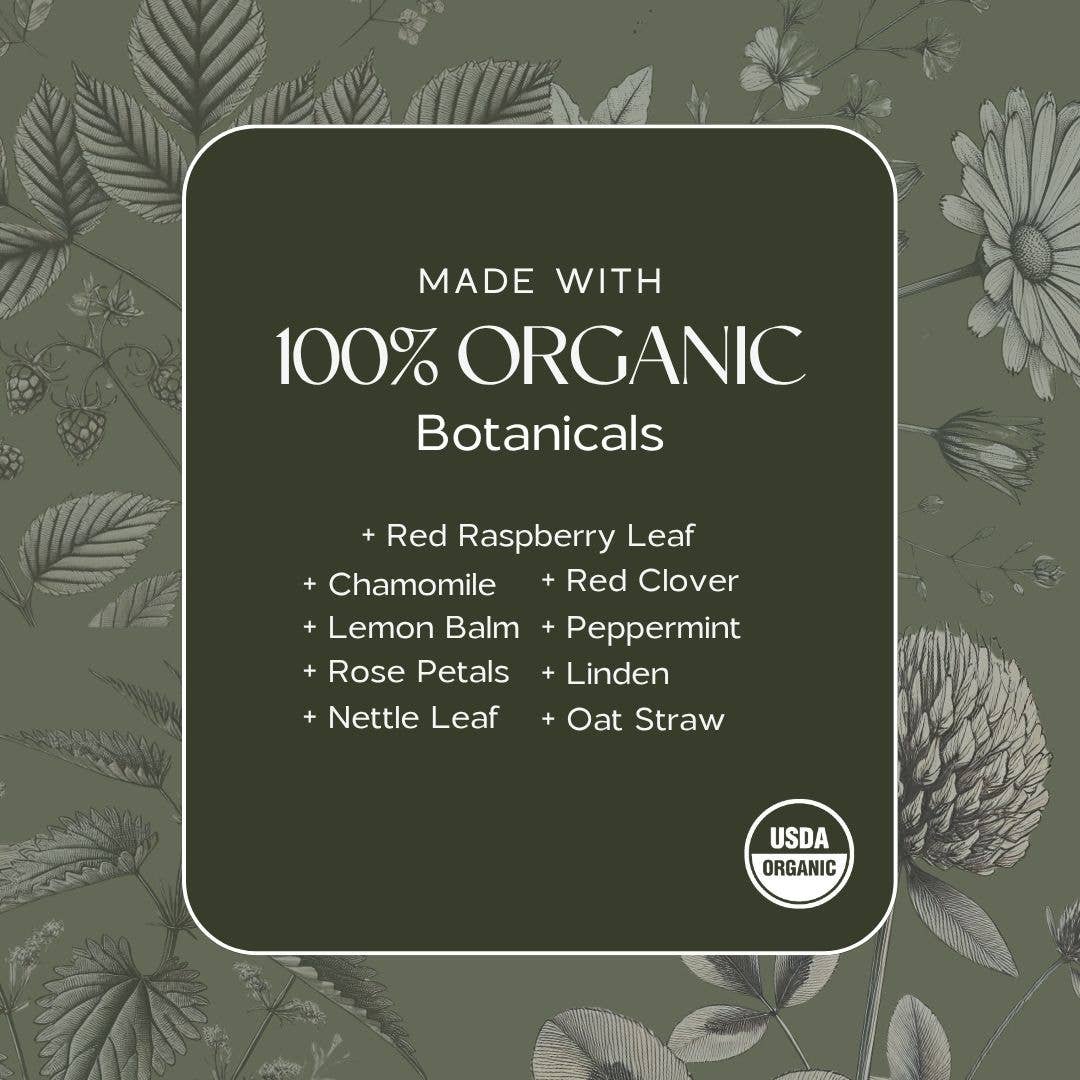
Raspberry Leaf (Rubus idaeus) · Chamomile Flower (Matricaria chamomilla) · Lemon Balm (Melissa officinalis) · Rose Petals (Rosa spp.) · Nettle Leaf (Urtica dioica) · Red Clover Flower (Trifolium pratense) · Peppermint Leaf (Mentha piperita) · Linden Flower (Tilia cordata) · Oat Straw (Avena sativa)
Raspberry Leaf, Chamomile Flower, Lemon Balm, Red Clover Flower, Peppermint Leaf, and Linden Flower are USDA Certified Organic. Rose Petals, Nettle Leaf, and Oat Straw are responsibly wildcrafted based on seasonal availability. Full plant profiles below.
The Plants
Raspberry Leaf (Rubus idaeus) has been in women's cups for longer than most of us can trace — not because anyone prescribed it, but because women found it and kept finding it, dried it, steeped it, passed it forward. It is a mineral-rich herb that gives something back to the body during the time of greatest release. That is where this formula begins: with the understanding that the menstrual phase is a time of giving out, and that the plants gathered here are ones that give back.
Lemon Balm (Melissa officinalis) and Linden Flower (Tilia cordata) tend to the emotional body. The menstrual phase can arrive with a particular kind of sensitivity — a thinning of the membrane between inner and outer that can feel like overwhelm before it finds its deeper intelligence. These are the herbs that soften that threshold, that support the nervous system in staying warm and present rather than bracing against itself. The blend would not be the same without them.
Rose Petals (Rosa spp.) are not here for decoration. Rose has a long tradition in women's plant medicine as a heart-softening botanical — gentle and belonging to the emotional body more than the physical one. In this formula she holds the center, the way a slow breath holds a difficult moment. She is the reason this tea asks something of you before you drink it: a pause, a reception, a willingness to soften.
Nettle Leaf (Urtica dioica) and Oat Straw (Avena sativa) bring the mineral foundation. The body's need for nourishment during the menstrual phase is real and often unmet. These two herbs, rooted in the nourishing infusion tradition, quietly tend to that depletion without performance. Peppermint (Mentha piperita) brightens the blend and supports the gentleness of digestion. Red Clover (Trifolium pratense) adds a soft sweetness and whole-body nourishment. Chamomile (Matricaria chamomilla) closes the circle with its steady, quiet calm. Together these nine plants form a complete portrait of what the menstrual body asks for — not as a course of treatment, but as a daily practice of remembering to receive.
The Lineage
Every herb in this blend was sourced the way it has always been sourced: with attention to season, to origin, and to what the plant is actually offering at the moment of harvest. The raspberry leaf, chamomile, and lemon balm are USDA Certified Organic. The rose petals, nettle, and oat straw are responsibly wildcrafted, gathered from places where they grow as they are meant to grow. Blended in small batches in Los Angeles. Nothing rushed. Nothing outsourced.
The Practice
Bring fresh water to just below a boil and pour it over a heaping tablespoon of the blend. Let it steep, covered, for eight to ten minutes. Sip slowly, one to three cups throughout the day, beginning in the few days before bleeding and continuing through the menstrual phase. The cover matters: it holds the volatile oils that carry the plants' most delicate properties. This is not a tea to drink standing at the counter. It is a cup that asks you to sit down.
The Formula
Raspberry Leaf (Rubus idaeus) · Chamomile Flower (Matricaria chamomilla) · Lemon Balm (Melissa officinalis) · Rose Petals (Rosa spp.) · Nettle Leaf (Urtica dioica) · Red Clover Flower (Trifolium pratense) · Peppermint Leaf (Mentha piperita) · Linden Flower (Tilia cordata) · Oat Straw (Avena sativa)
Raspberry Leaf, Chamomile Flower, Lemon Balm, Red Clover Flower, Peppermint Leaf, and Linden Flower are USDA Certified Organic. Rose Petals, Nettle Leaf, and Oat Straw are responsibly wildcrafted based on seasonal availability. Full plant profiles below.
Tasting Notes
soft · floral · gently minty · lightly earthy
Ritual Moment
the days before and throughout the bleed
Season of Life
any woman in her menstrual season
Energetics
softening · nourishing · settling
Tasting Notes
soft · floral · gently minty · lightly earthy
Ritual Moment
the days before and throughout the bleed
Season of Life
any woman in her menstrual season
Energetics
softening · nourishing · settling

Rose Petals
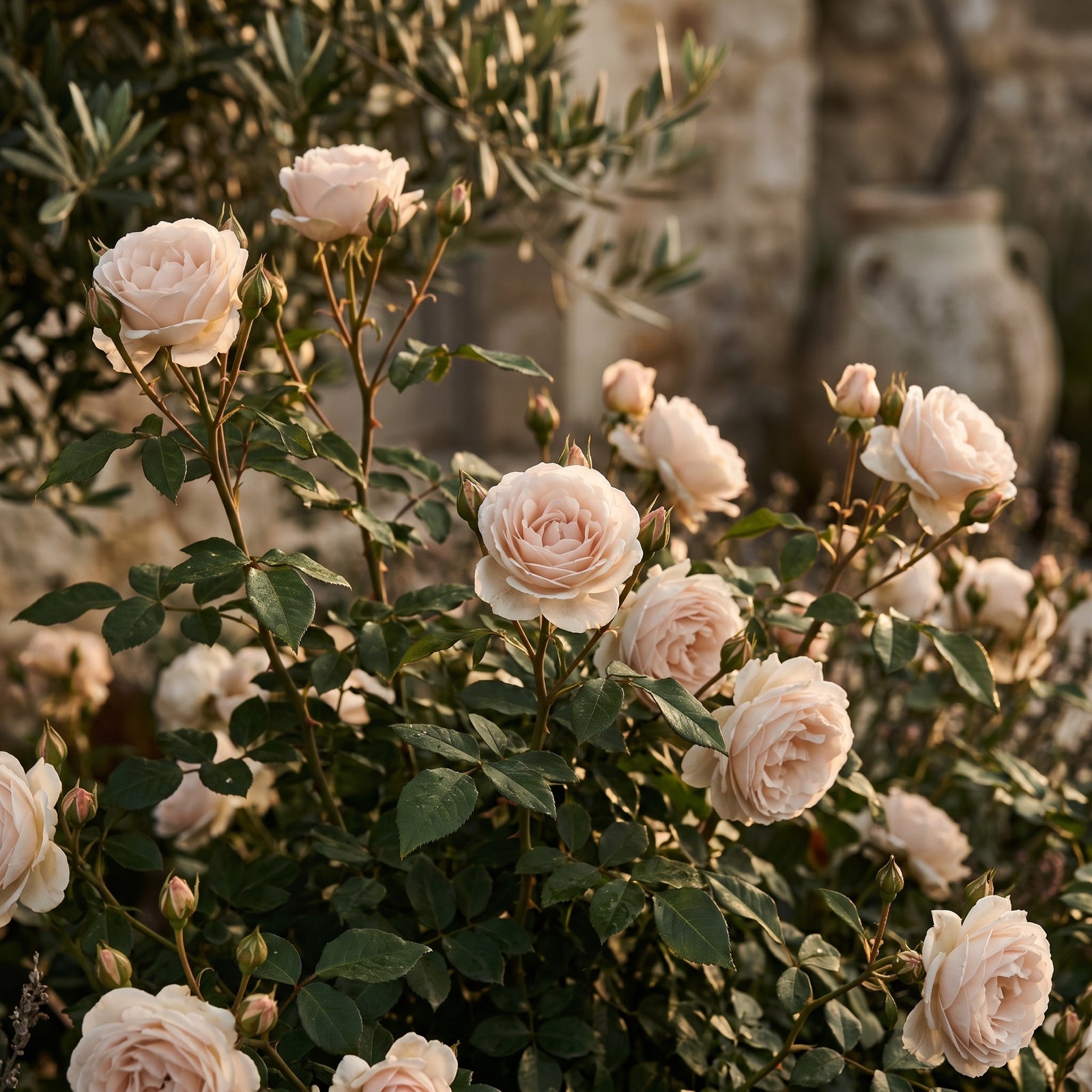
There is a tenderness to working with Rose that I have never been able to explain and have stopped trying to. These petals belong to a tradition of plant medicine that centers the emotional body rather than the physical one, the heart more than the hormones. I add Rose to this formula because the menstrual phase is not only a physical event — it is a time of emotional openness that can be overwhelming or deeply clarifying depending entirely on whether the woman inside it is being held. Rose holds. She always has.
Raspberry Leaf
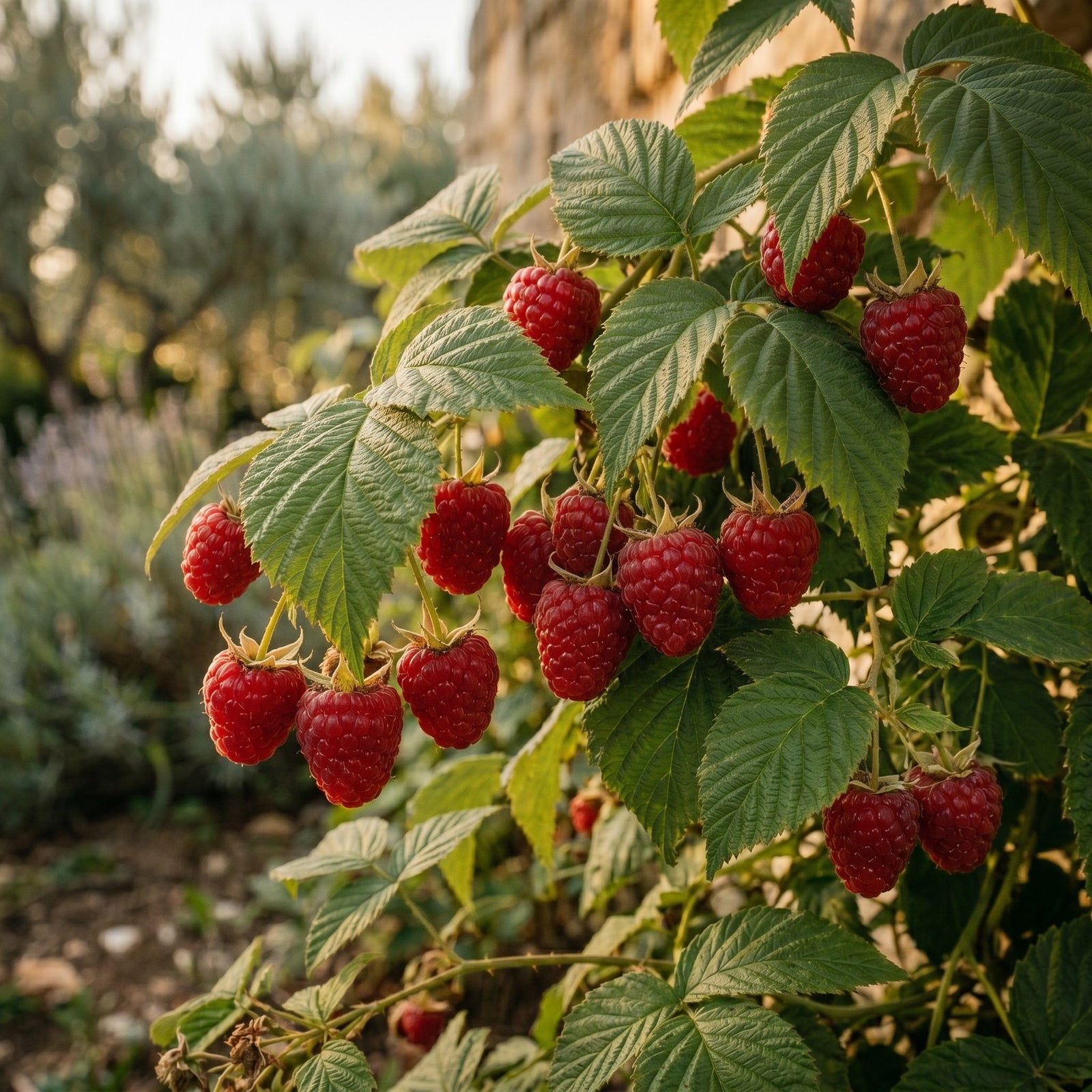
Raspberry Leaf grows along roadsides and forest edges in temperate climates — a plant that has always thrived at the threshold between wild and tended places. I find something true in that image for an herb that has lived at the edge of women's medicine for centuries, never quite entering the mainstream and never quite leaving it either. Women have dried these leaves and steeped them across every season of womanhood. What I know from working with it is that it gives something mineral and grounding back to the body — a quiet replenishment that the body recognizes, even when the mind doesn't have a name for it. It is the foundation of this formula for the same reason it has been in women's cups for generations: because it belongs there.
Lemon Balm
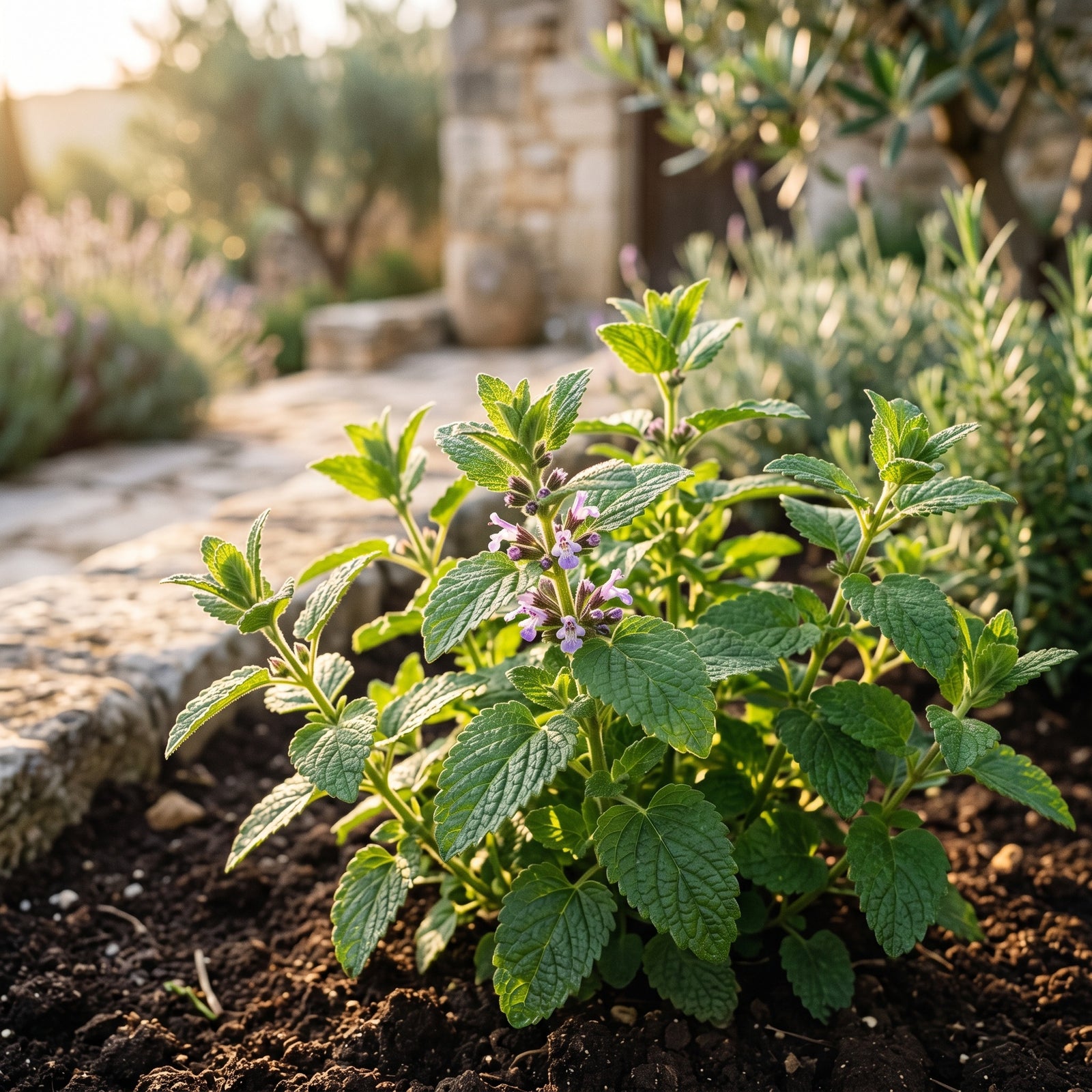
Lemon Balm grows almost too easily, and I have always thought that says something about its character — an herb that shows up where it is needed, spreads freely, and gives without reservation. In women's cycle work, I reach for it in the luteal and menstrual phases, when the emotional body becomes more permeable and the nervous system needs something that steadies without shutting down. There is a brightening quality to lemon balm, a way it lifts the spirit without overriding what the body is already doing. That is rare in an herb, and particular to this one. It is why it is in this cup.
Nettle Leaf
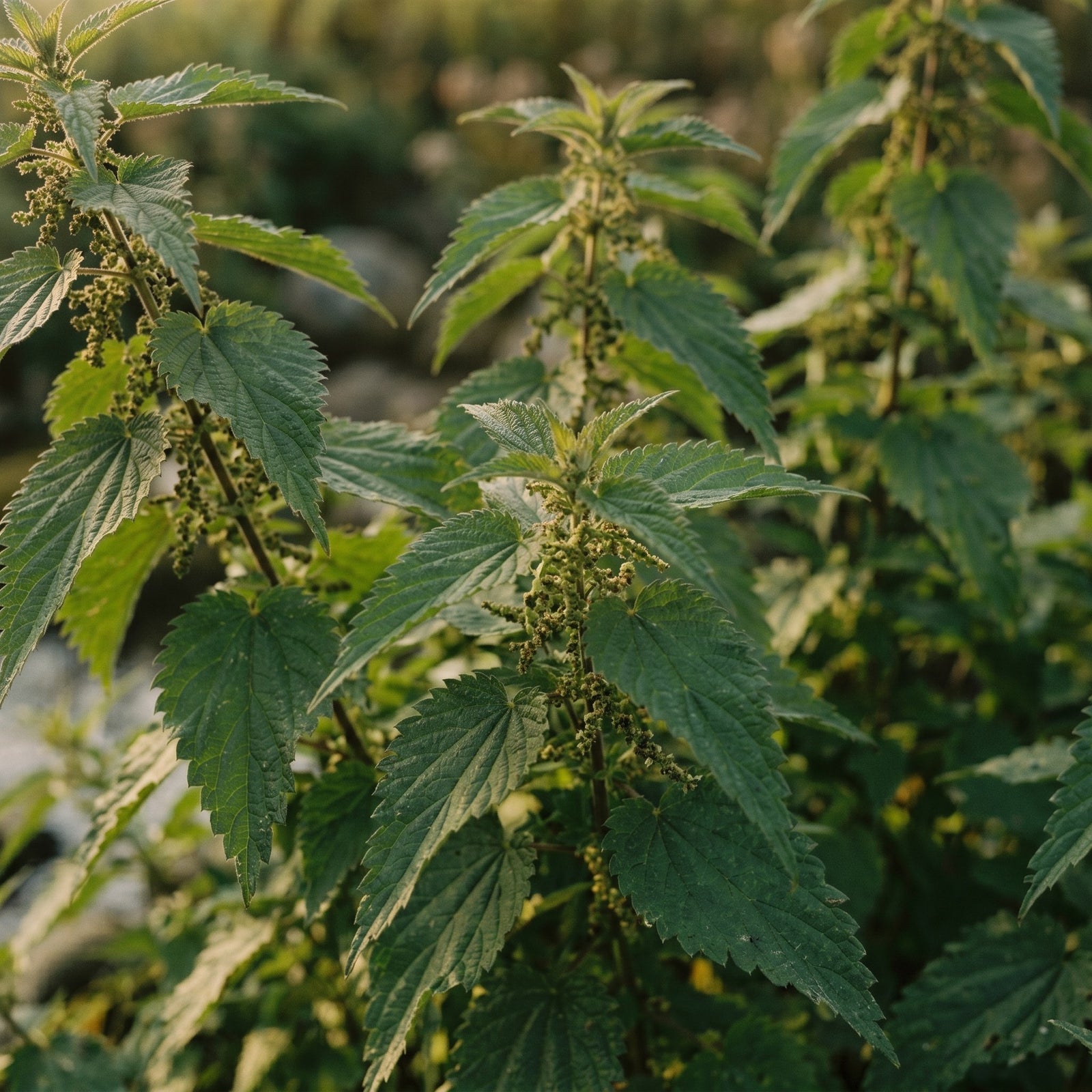
Nettle earns its place without trying to charm you. It does not carry the romantic qualities of Rose or the bright lift of Lemon Balm — it is mineral-rich, deeply nourishing, and unglamorous in the way that real support often is. I think of it as the herb that quietly replenishes what the body gives out during the bleeding time, working at a depth that goes below the surface. In the nourishing infusion tradition, where herbs steep long and the body receives their full mineral depth, nettle is a cornerstone. This tea does not steep as long as a true infusion, but the nettle is there, doing its work, the way good support always is.

Rose Petals
There is a tenderness to working with Rose that I have never been able to explain and have stopped trying to. These petals belong to a tradition of plant medicine that centers the emotional body rather than the physical one, the heart more than the hormones. I add Rose to this formula because the menstrual phase is not only a physical event — it is a time of emotional openness that can be overwhelming or deeply clarifying depending entirely on whether the woman inside it is being held. Rose holds. She always has.

Raspberry Leaf
Raspberry Leaf grows along roadsides and forest edges in temperate climates — a plant that has always thrived at the threshold between wild and tended places. I find something true in that image for an herb that has lived at the edge of women's medicine for centuries, never quite entering the mainstream and never quite leaving it either. Women have dried these leaves and steeped them across every season of womanhood. What I know from working with it is that it gives something mineral and grounding back to the body — a quiet replenishment that the body recognizes, even when the mind doesn't have a name for it. It is the foundation of this formula for the same reason it has been in women's cups for generations: because it belongs there.

Lemon Balm
Lemon Balm grows almost too easily, and I have always thought that says something about its character — an herb that shows up where it is needed, spreads freely, and gives without reservation. In women's cycle work, I reach for it in the luteal and menstrual phases, when the emotional body becomes more permeable and the nervous system needs something that steadies without shutting down. There is a brightening quality to lemon balm, a way it lifts the spirit without overriding what the body is already doing. That is rare in an herb, and particular to this one. It is why it is in this cup.

Nettle Leaf
Nettle earns its place without trying to charm you. It does not carry the romantic qualities of Rose or the bright lift of Lemon Balm — it is mineral-rich, deeply nourishing, and unglamorous in the way that real support often is. I think of it as the herb that quietly replenishes what the body gives out during the bleeding time, working at a depth that goes below the surface. In the nourishing infusion tradition, where herbs steep long and the body receives their full mineral depth, nettle is a cornerstone. This tea does not steep as long as a true infusion, but the nettle is there, doing its work, the way good support always is.
The Ritual
Practices that support the plants
Honor yourself
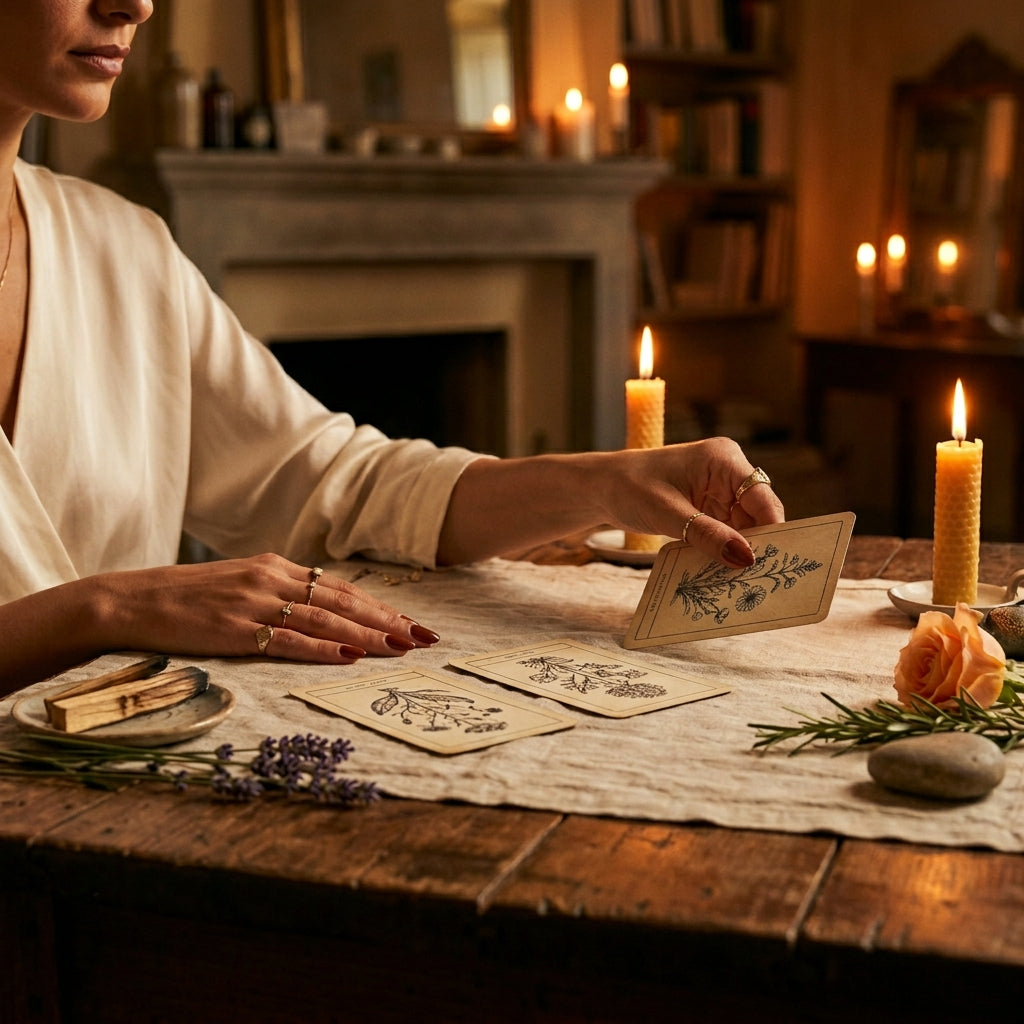
Pull a card tonight
Draw three cards and place them in a line before you — the first for what you are releasing with this cycle, the second for what the inward season is showing you, the third for what you are being asked to receive. Sit with each one long enough to feel a response before you reach for an explanation. If cards are not your thing, write your answers to the same three questions — the questions are the practice, the cards are just a doorway.

Return to the body
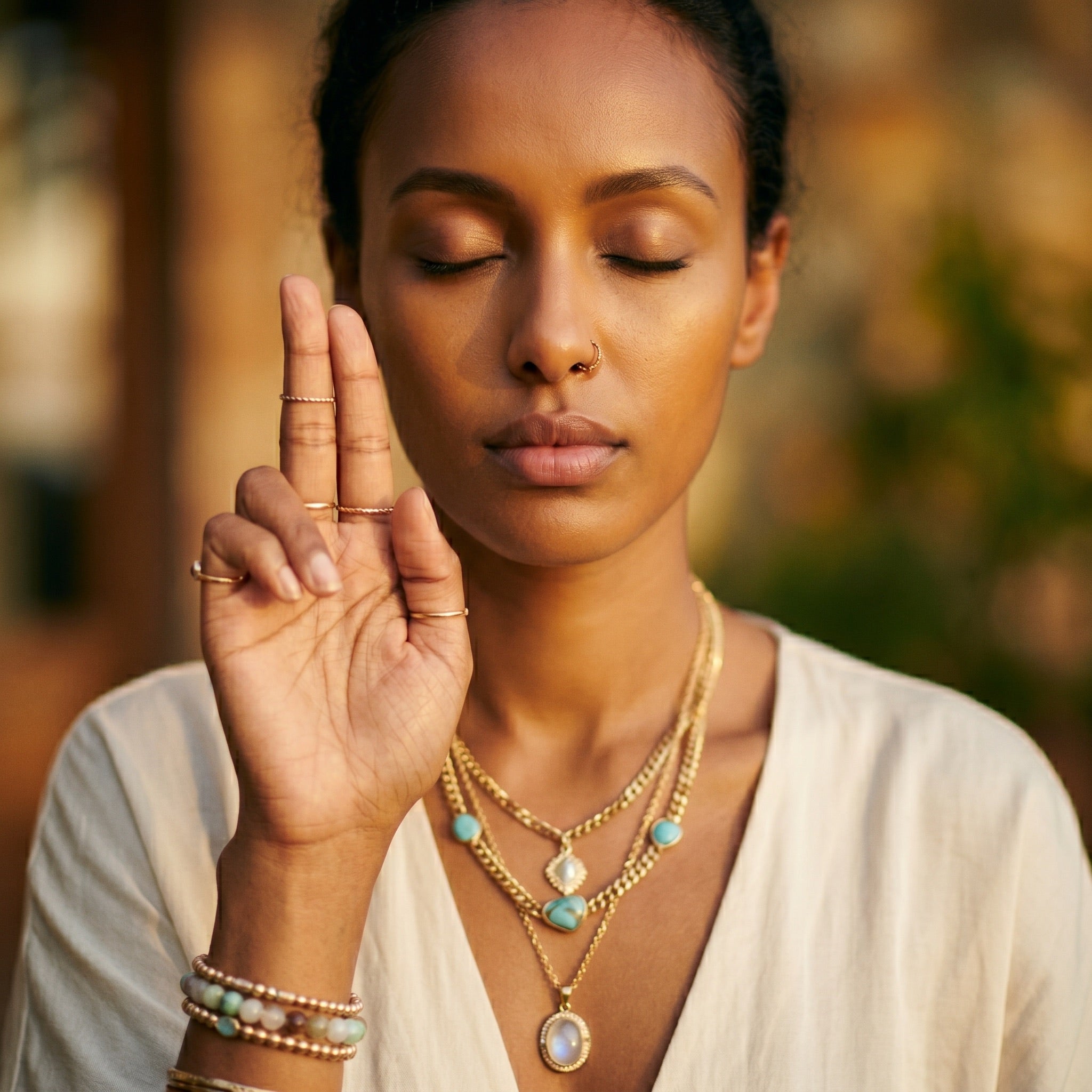
Nadi Shodhana
Close your right nostril with your right thumb, inhale through the left for a count of four, then close the left with your ring finger, hold for four, and exhale through the right for four — pause four before the next inhale. This is Nadi Shodhana, the alternate nostril breath that balances the ida and pingala nadis, the lunar and solar channels in yogic tradition. During the menstrual phase, when the lunar channel naturally dominates, eight rounds of this breath settles the emotional body without suppressing the inward quality the season asks for.

Remember the earth
Stand in the dark
On the darkest night you can find during your bleed, go outside — no phone, no light — and stand still for five minutes. Ancestral traditions across cultures understood the dark of the moon as the time of the bleeding woman: a moment of maximum inward pull, when stillness in outdoor darkness does something to the nervous system that indoor darkness cannot. The plants in your cup tonight were grown under a sky like this one.

Jasmine's Note
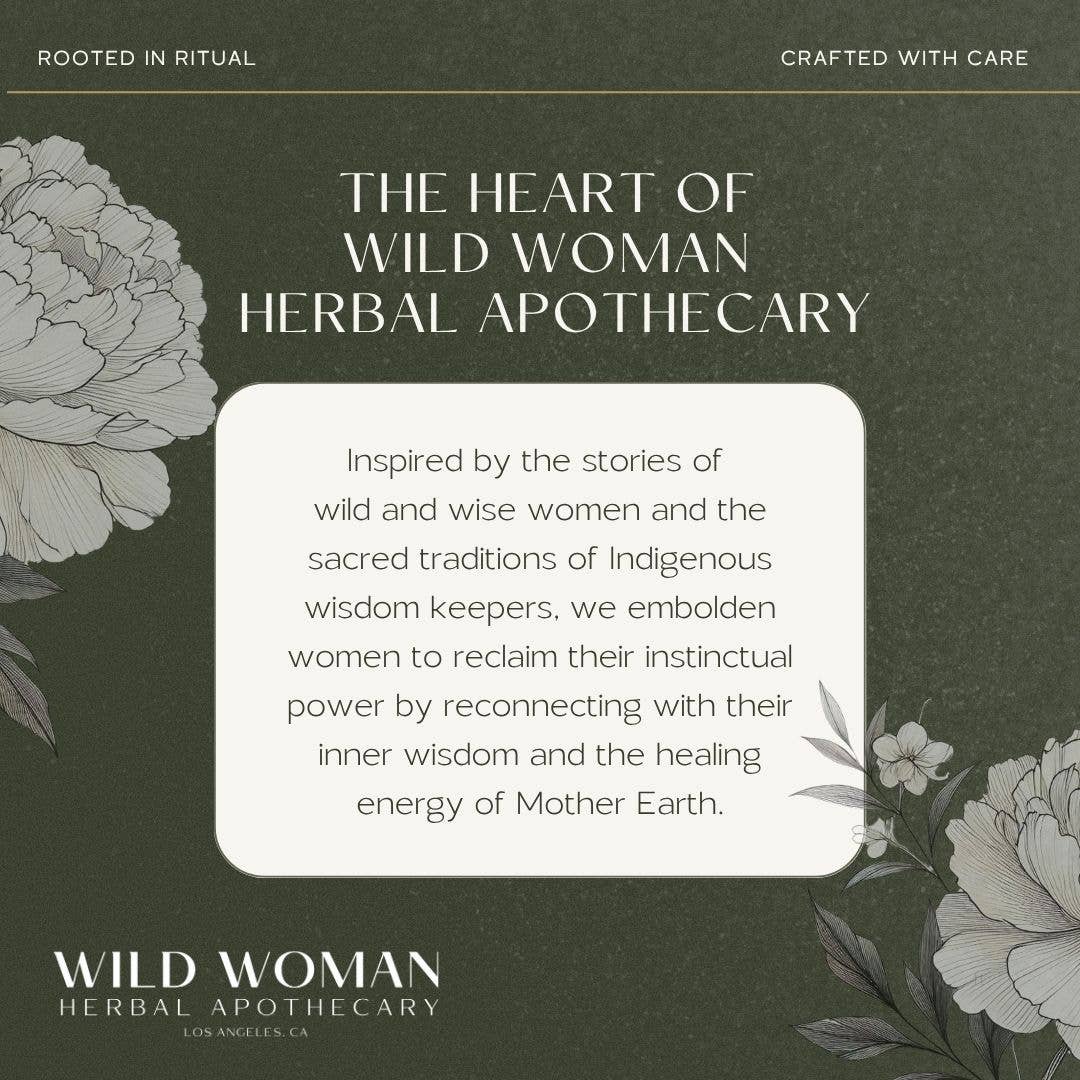
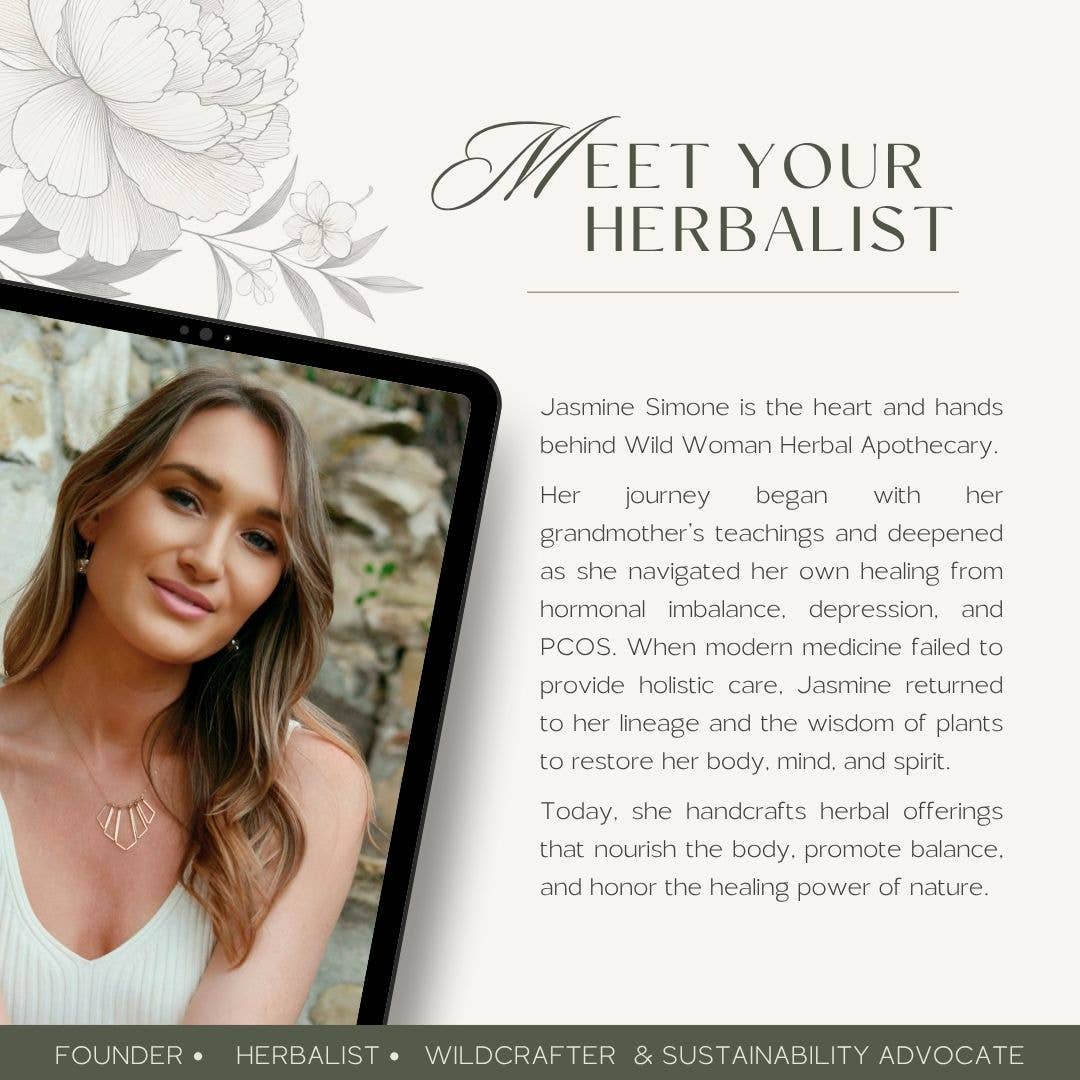
I didn't fully understand what I'd inherited until my own body started asking questions that medicine couldn't answer. Hormonal chaos, long seasons of depression, the particular exhaustion of feeling disconnected from yourself. I remembered the whisperings. I turned back toward the plants. Everything in this apothecary came from that turning — things I made for myself first, and then for the women in my life who needed the same. I offer them to you the way my grandmother offered what she knew: as a hand extended, as something real.
-Jasmine

Rooted in Lineage. Made with Reverence.
This is medicine in the oldest sense of the word: plant wisdom, carefully tended, passed forward with care.
Frequently Asked Questions
What is Moon Cycle Support and how does it work as an herbal tea for menstrual support?
Moon Cycle Support is an herbal tea for menstrual support, blended from nine organic and wildcrafted botanicals traditionally used to nourish the body and support emotional steadiness throughout the menstrual cycle. The formula centers Raspberry Leaf (Rubus idaeus) as its mineral-rich foundation, with Lemon Balm (Melissa officinalis) and Linden Flower (Tilia cordata) for nervous system calm, and Rose Petals (Rosa spp.) for emotional softness during the cycle's most sensitive days. It is designed as a daily ritual — something to return to throughout the menstrual phase, not a single-cup solution. Brewed slowly and held warm, it is an invitation to receive rather than push through.
What does raspberry leaf tea do for the menstrual cycle?
Raspberry Leaf (Rubus idaeus) has a long tradition in women's herbal medicine as a mineral-rich nourishing herb, particularly during times when the body is releasing and needs replenishment. Women have steeped and dried it for centuries not because it addresses a single symptom, but because it tends to the whole body during the menstrual phase with a quiet, consistent depth that goes below the surface. In Moon Cycle Support it forms the mineral foundation alongside Nettle Leaf (Urtica dioica) and Oat Straw (Avena sativa) — three herbs that have long been used together in the nourishing infusion tradition. We always recommend checking with your healthcare provider before beginning any new herbal practice, especially during pregnancy or nursing.
What is lemon balm good for during your cycle?
Lemon Balm (Melissa officinalis) is a nervine herb traditionally used to support emotional steadiness and gently uplift the spirit — qualities that become especially relevant in the luteal and menstrual phases, when emotional sensitivity tends to heighten. In Moon Cycle Support, it works alongside Linden Flower (Tilia cordata) to support the nervous system's capacity to stay warm and present rather than reactive during the cycle's most inward days. It has a bright, citrusy quality on the tongue that lifts the whole blend. It is the herb in this formula I reach for most personally in the days before my bleed arrives.
Can I drink Moon Cycle Support throughout my whole cycle, or only during my period?
Moon Cycle Support was designed as a daily ritual menstrual cycle tea for the full cycle, not only the bleeding days. The mineral nourishment of Nettle Leaf (Urtica dioica), Oat Straw (Avena sativa), and Raspberry Leaf (Rubus idaeus) supports the body throughout the month, and many women find the emotional grounding of Lemon Balm and Rose most meaningful when they begin a few days before the bleed arrives, as the luteal phase deepens. One to three cups a day is a natural rhythm. Begin whenever the body asks.
Is Moon Cycle Support safe during pregnancy?
Some herbs in this formula have traditional uses in pregnancy, and some — including Red Clover (Trifolium pratense) and Peppermint (Mentha piperita) — are ones we recommend reviewing with your care provider before use during pregnancy or nursing. We always recommend checking with your healthcare provider before beginning any new herbal practice if you are pregnant, managing a health condition, or taking medication. If you are in your third trimester and looking for a tea formulated specifically for that season, our Labor of Love blend was made with that particular moment in mind.
What does Moon Cycle Support taste like?
Moon Cycle Support has a soft, rounded flavor — gently floral from the Chamomile (Matricaria chamomilla), Linden (Tilia cordata), and Rose Petals (Rosa spp.), with a cool brightness from Peppermint (Mentha piperita) and a mild earthiness underneath from the Raspberry Leaf (Rubus idaeus), Nettle (Urtica dioica), and Oat Straw (Avena sativa). It is not medicinal-tasting — pleasant enough to drink throughout the day without sweetener, though a touch of honey deepens the floral notes. Steep it covered for the full ten to fifteen minutes to draw out the mineral depth the blend holds.
A Note on Plant Medicine
Plants are powerful — and like any potent thing, they deserve to be used with care and knowledge. These formulas are crafted with intention, but they are not a substitute for medical guidance. Before beginning a new herbal practice, we encourage you to speak with your healthcare provider, especially if you are pregnant, nursing, trying to conceive, managing a health condition, or taking prescription medication. Wild Woman products are not intended to diagnose, treat, cure, or prevent any disease.
Stay close to the apothecary
THE LETTER
Herbal rituals for every season of womanhood
Sent four times a year, when the season turns. Plant wisdom, slow writing, and occasional notes from the bench. No promotions, no urgency.
SMALL BATCH
Made by hand in our Los Angeles apothecary
WILDCRAFTED & ORGANIC
Herbs gathered seasonally or grown by farmers we trust
CRAFTED SLOWLY
Each formula prepared without rushing for scale
ROOTED IN LINEAGE
In the tradition of the women who have come before us